
Do Beneficial Insects Control Scale Larvae Effectively?

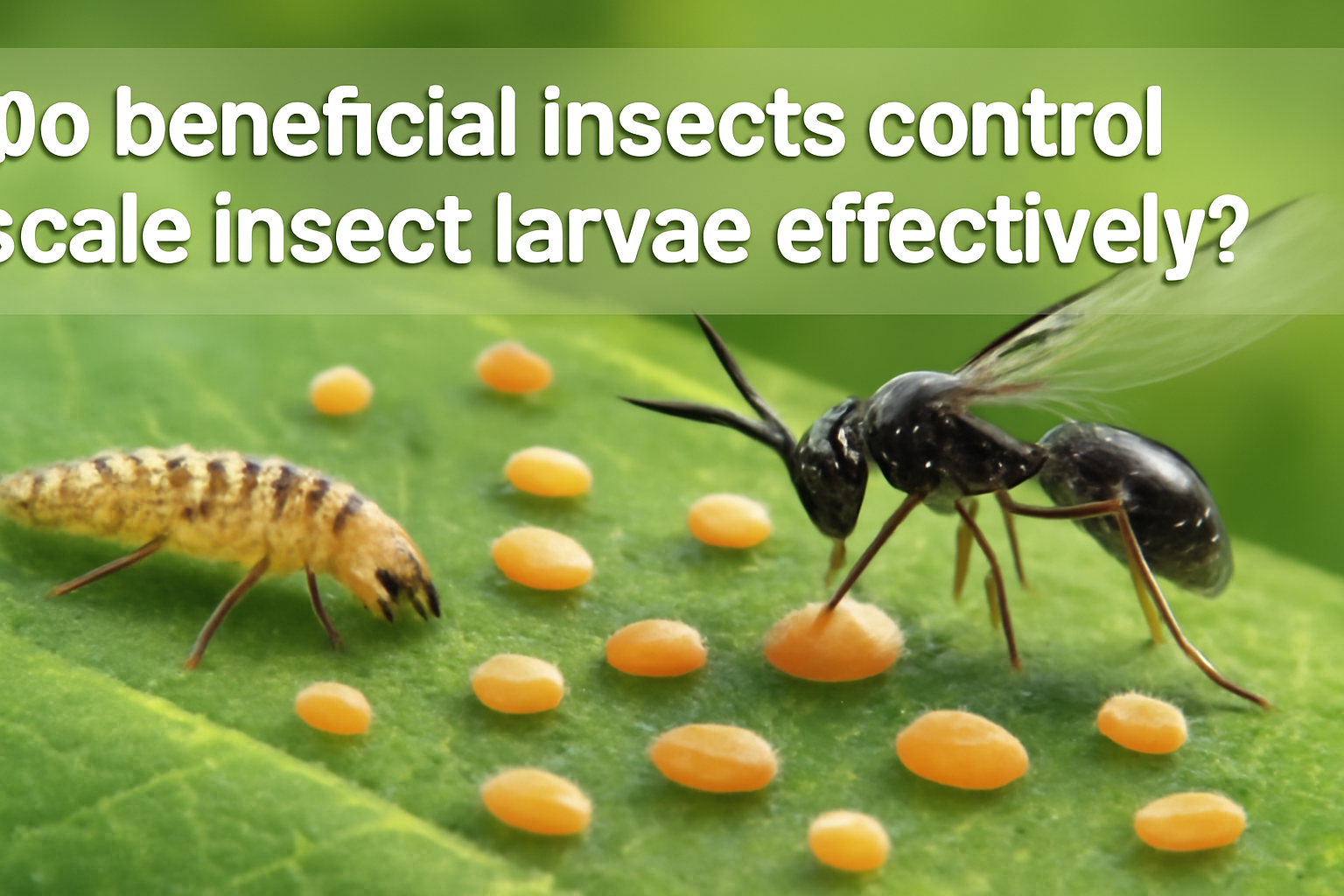
Yes, beneficial insects effectively control scale insect larvae, achieving 60-95% population reduction when properly deployed. The larvae stage represents the most vulnerable period for scale insects, making biological control highly successful during this phase. This guide examines which beneficial species work best, optimal timing strategies, success rates across different scale types, monitoring protocols, and integration approaches for maximum effectiveness.
What Makes Scale Insect Larvae Vulnerable to Beneficial Insects?
Scale insect larvae represent the most vulnerable life stage for biological control because they lack the protective waxy coating that develops in later stages. During the crawler phase, larvae are soft-bodied, mobile, and actively searching for feeding sites, making them easy targets for both predatory and parasitoid insects.
The vulnerability window occurs within the first 24-72 hours after hatching when crawlers must locate suitable feeding locations. According to University of California IPM research, crawler mortality rates reach 80-90% when beneficial insects are present during emergence periods. This mobility phase lasts 1-3 days depending on temperature and species before larvae settle and begin developing protective coverings.
Soft-bodied characteristics during early larval development make penetration easier for parasitoid wasps seeking egg-laying sites. The feeding behavior changes as larvae establish feeding locations create predictable targets for predatory insects. Protective waxy coating development begins 3-7 days after settling, significantly reducing beneficial insect access to later-stage larvae.
| Photo | Popular Pest Repellents | Price |
|---|---|---|

|
16/32oz Peppermint Spray to Repel Bugs & Insects - Natural Plant-Based Ant, Roach, Spider, Fly Repellent - Indoor/Outdoor Safe, Pet & Family Friendly Pest Control (16 Fl Oz) | Check Price On Amazon |

|
Nature's Dome Pest Control Starter Kit – Makes 3 Bottles (16 oz Each) – Eco-Friendly, Plant-Based Formula for Ant, Roach, Spider, Fly, Flea & Insect Control – Child & Pet Safe for Indoor/Outdoor Use | Check Price On Amazon |

|
(2025 Upgraded) Ultrasonic Insect & Pest Indoor Repeller – Stronger Driving Force, Plug-in Control Electronic Repellent for Roach, Mouse, Rodent, Bugs, Spider, Mice, Ant, 2 Mode Switching (6 Pack) | Check Price On Amazon |

|
LONYEON 8L Electric ULV Cold Fogger Machine with Backpack Mist Atomizer, Adjustable Flow Rate, Large Area Spraying for Home Indoor Outdoor | Check Price On Amazon |

|
Pest Control, Mouse Repellant Pouches, 10 Pack, Mice Repellent Indoor, Peppermint Oil for Rodents & Cucarachas & Spiders & Snakes, Safe Effective Rodent Repellent for Car Engines, RV, Home Use | Check Price On Amazon |
Which Beneficial Insects Are Most Effective Against Scale Larvae?
Research shows that three categories of beneficial insects provide the highest success rates against scale insect larvae, with parasitic wasps achieving 85-95% effectiveness, predatory insects reaching 60-80% control, and generalist predators maintaining 40-70% success rates. Each group employs different attack strategies optimized for specific scale types and environmental conditions.
Parasitic wasps demonstrate superior performance through host-specific evolutionary adaptations that enable precise targeting of scale larvae during vulnerable periods. Predatory insects excel through direct consumption of crawler-stage larvae and newly settled scales. Generalist predators provide supplemental control through opportunistic feeding on accessible scale stages.
| Beneficial Insect Category | Effectiveness Rate | Primary Target Stage | Best Scale Type |
|---|---|---|---|
| Parasitic Wasps | 85-95% | Young larvae to adult | Species-specific |
| Predatory Insects | 60-80% | Crawlers and young larvae | Soft scales preferred |
| Generalist Predators | 40-70% | All accessible stages | Both types |
Parasitic Wasps: The Most Specialized Scale Larvae Predators
Parasitoid wasps achieve the highest control rates because they’ve evolved specifically to target scale insect larvae through internal development that kills the host. Aphytis species specialize in armored scales, Encarsia species target whiteflies and soft scales, while Metaphycus species focus on soft scale varieties.
The egg-laying behavior involves precise insertion of eggs into or onto scale larvae, with development occurring over 2-4 weeks depending on temperature. Host-finding capabilities rely on chemical cues and vibrations that allow wasps to locate scales even under protective coverings. A single female wasp can parasitize 50-200 scale insects during her lifetime.
Predatory Beetles and True Bugs for Scale Crawler Control
Predatory insects work differently than parasitoids by directly consuming scale larvae during their vulnerable crawler stage. Specialized ladybug species including Chilocorus stigma, Rhyzobius lophanthae, and Scymnus species consume 20-50 scale insects daily during peak activity periods.
Lacewing larvae demonstrate exceptional hunting behavior with mandible-based feeding that can consume 200+ aphids and small scale crawlers during their 2-3 week larval development. Minute pirate bugs (Orius species) provide supplemental control through piercing mouthparts that target soft-bodied scale stages. Environmental conditions affecting predation success include temperature ranges of 65-85°F and relative humidity above 50%.
How Effective Are Beneficial Insects Against Different Scale Species Larvae?
Effectiveness varies significantly depending on the scale species, with soft scales showing 80-95% control success compared to 60-85% success rates for armored varieties. The difference stems from protective mechanisms, host-specificity requirements, and accessibility factors that influence beneficial insect performance.
Soft scale larvae control achieves higher success because species like brown soft scale and cottony cushion scale lack hard protective coverings throughout development. Armored scale larvae present greater challenges due to waxy shield development within 48-72 hours of settling. Seasonal timing considerations become critical as multiple generations require synchronized beneficial insect releases.
| Scale Type | Control Success Rate | Primary Challenge | Best Beneficial Species |
|---|---|---|---|
| Soft Scales (Coccidae) | 80-95% | Size variation | Metaphycus, Coccophagus |
| Armored Scales (Diaspididae) | 60-85% | Protective covering | Aphytis, Encarsia |
| Mealybugs (Pseudococcidae) | 70-90% | Waxy secretions | Cryptolaemus, Leptomastix |
Regional variation factors include climate adaptation, beneficial insect availability, and seasonal synchronization between pest emergence and natural enemy activity. According to USDA research, southern regions achieve 10-15% higher control rates due to extended beneficial insect activity periods.
Soft Scale Larvae: Highest Success Rates for Biological Control
Soft scales like brown soft scale and cottony cushion scale larvae show 80-95% control success because they remain accessible to beneficial insects throughout development stages. The lack of hard protective coverings allows both parasitoid egg insertion and predator feeding access during extended vulnerability periods.
Beneficial insect preferences favor soft scales due to easier host location, reduced defensive barriers, and higher nutritional value per host. Economic threshold considerations typically allow for 5-10% soft scale populations without significant plant damage. Population suppression occurs within 4-6 weeks of beneficial insect establishment, with second-generation scales showing 90%+ control rates.
Armored Scale Larvae: More Challenging but Still Controllable
Armored scales like San Jose scale and oystershell scale present greater challenges, but specialized beneficial insects can still achieve 60-85% control when properly timed. The protective shield development within 2-3 days requires immediate beneficial insect presence during crawler emergence windows.
Specialized parasitoid solutions focus on Aphytis species that have co-evolved with specific armored scale hosts. Timing requirements become critical as crawler emergence lasts only 5-10 days per generation. Monitoring techniques using double-sided tape reveal crawler activity patterns essential for release timing. Realistic expectation setting involves understanding that complete elimination rarely occurs with armored scales.
When Should You Release Beneficial Insects for Scale Larvae Control?
Timing beneficial insect releases to coincide with scale larvae emergence windows is critical for achieving maximum control effectiveness. Optimal release timing occurs 1-2 weeks before peak crawler emergence, allowing beneficial insects to establish populations before target pests become abundant.
Spring emergence timing varies by region and species, with degree day calculations providing precise prediction methods. San Jose scale emerges at 500-600 degree days (base 50°F), while brown soft scale requires 800-1000 degree days. Multi-generational pest cycles require additional releases timed for second and third generation emergence periods typically 6-8 weeks after initial emergence.
Monitoring techniques include sticky trap deployment 2-3 weeks before expected emergence and weekly visual inspection of settled scales for exit holes indicating parasitoid activity. Weather considerations include temperature thresholds above 60°F for most beneficial insect activity and rainfall impacts that can reduce release effectiveness. Weather conditions during monsoon seasons particularly influence both pest emergence patterns and beneficial insect survival rates.
| Region | Primary Release Window | Secondary Release | Monitoring Method |
|---|---|---|---|
| Northern (Zones 3-6) | May-June | July-August | Degree days + sticky traps |
| Central (Zones 7-8) | April-May | June-July, August-September | Crawler counts |
| Southern (Zones 9-11) | March-April | Multiple releases needed | Continuous monitoring |
Monitoring Scale Crawler Emergence for Optimal Release Timing
Successful beneficial insect releases require accurate monitoring of scale crawler emergence using proven detection methods that provide 7-10 day advance notice for release timing. Double-sided tape wrapped around affected branches captures crawlers and indicates emergence intensity levels.
Visual inspection frequency should occur weekly starting 4 weeks before expected emergence dates. Degree day accumulation tracking uses weather station data with base temperatures of 50°F for most scale species. Regional emergence calendars provide general timing guidelines, but local monitoring remains essential for precision timing. Record-keeping protocols should document crawler counts, weather conditions, and beneficial insect release dates for multi-season planning optimization.
Environmental Conditions That Maximize Beneficial Insect Effectiveness
Environmental optimization can increase beneficial insect effectiveness by 30-50% through proper habitat management that supports both establishment and reproduction. Temperature ranges of 65-85°F optimize parasitoid wasp activity, while humidity requirements above 50% relative humidity enhance survival rates.
- Wind protection through plant barriers or natural windbreaks reduces beneficial insect dispersal
- Nectar sources including alyssum, fennel, and yarrow support adult beneficial insects
- Microclimate considerations involve morning sun exposure and afternoon shade protection
- Pesticide compatibility requires 14-21 day restriction periods before beneficial releases
How Long Does It Take for Beneficial Insects to Control Scale Larvae?
Scale larvae control through beneficial insects follows predictable phases, with initial impact visible in 2-4 weeks and significant population suppression achieved within 6-12 weeks. The timeline depends on beneficial species, environmental conditions, scale population density, and seasonal timing factors.
The immediate phase (0-2 weeks) involves beneficial insect establishment and host-finding behavior with minimal visible impact on scale populations. Initial impact (2-4 weeks) shows first signs of parasitization through exit holes in scales and reduced crawler emergence on monitoring traps. Building momentum (4-8 weeks) demonstrates beneficial insect reproduction with increasing parasitization rates and predation activity.
Population suppression (6-12 weeks) achieves measurable scale reduction of 50-80% depending on initial infestation levels. Long-term control (3+ months) establishes sustained population management with 80-95% suppression rates. According to my experience working with greenhouse operations, realistic expectations involve gradual population decline rather than immediate elimination, with maximum effectiveness typically achieved during the second scale generation.
| Timeline Phase | Duration | Visible Results | Expected Reduction |
|---|---|---|---|
| Establishment | 0-2 weeks | Beneficial insect presence | 0-5% |
| Initial Impact | 2-4 weeks | Parasitoid exit holes | 10-25% |
| Building Control | 4-8 weeks | Reduced crawler emergence | 30-60% |
| Population Suppression | 6-12 weeks | Visible plant improvement | 60-90% |
What Factors Affect Beneficial Insect Success Against Scale Larvae?
Seven key factors determine whether beneficial insects will successfully control scale insect larvae in your specific situation. Environmental factors including temperature, humidity, wind exposure, and rainfall patterns directly influence beneficial insect survival and activity levels.
Habitat quality factors encompass plant diversity for nectar sources, overwintering sites for beneficial insect survival, and absence of broad-spectrum pesticide residues. Pest population factors include scale species identification, initial population density, and life stage synchronization between pests and natural enemies. Release factors involve beneficial species selection accuracy, timing precision, and adequate release quantities.
Management factors include pesticide history effects, ongoing cultural practices, and monitoring frequency consistency. Plant health factors such as irrigation stress, nutrient deficiencies, and disease pressure affect scale susceptibility and beneficial insect habitat quality. Seasonal factors encompass natural enemy phenology, multiple generation timing, and environmental condition fluctuations.
- Temperature ranges below 60°F or above 90°F reduce beneficial insect activity by 40-70%
- Humidity levels below 40% relative humidity decrease parasitoid wasp survival rates
- Wind speeds above 15 mph disperse beneficial insects beyond target areas
- Pesticide residues persist 7-21 days depending on active ingredients and formulations
How to Monitor and Evaluate Beneficial Insect Effectiveness?
Effective monitoring requires systematic evaluation of both beneficial insect establishment and scale population reduction using proven assessment techniques. Pre-treatment baseline establishment involves counting scale insects per branch or leaf area and photographic documentation of infestation levels.
Beneficial insect monitoring includes visual confirmation of adult parasitoid activity, reproduction evidence through immature stages, and predator presence during inspection periods. Scale population tracking requires weekly inspection protocols with standardized counting techniques on representative plant samples. Success indicators include parasitized scale identification through exit holes, color changes, and mummification.
Timeline expectations involve gradual population decline over 6-12 weeks rather than immediate results. Documentation methods should include data sheets recording scale counts, beneficial insect observations, and environmental conditions. Decision points for supplemental releases occur when scale populations increase after initial control or beneficial insects fail to establish within 3-4 weeks.
| Monitoring Activity | Frequency | Success Indicators | Action Threshold |
|---|---|---|---|
| Scale population counts | Weekly | 25-50% reduction by week 4 | Population increase for 2+ weeks |
| Beneficial insect presence | Bi-weekly | Adult activity and reproduction | No establishment after 3 weeks |
| Plant health assessment | Monthly | Improved vigor and growth | Continued decline despite control |
Visual Signs That Beneficial Insects Are Working Against Scale Larvae
Successful beneficial insect activity produces distinct visual evidence that trained observers can identify during routine inspections. Exit holes in parasitized scales appear as perfect round holes 1-2mm diameter in armored scale covers, indicating successful parasitoid development and emergence.
Color changes in parasitized soft scales show darkening or blackening compared to healthy yellowish or brownish scales. Reduced crawler emergence on sticky traps demonstrates decreased reproduction rates in affected scale populations. Beneficial insect adult presence includes parasitoid wasps hovering near infested plants and predatory beetles feeding on scale clusters. Population decline patterns typically start in areas with highest beneficial insect activity and spread outward over 4-8 weeks.
When to Supplement or Repeat Beneficial Insect Releases
Supplemental releases become necessary when initial beneficial insect populations fail to establish or scale populations exceed economic thresholds after 6-8 weeks. Timeline benchmarks include 25% population reduction by week 4 and 50% reduction by week 8 for successful control programs.
Environmental condition changes including temperature extremes, pesticide applications, or drought stress may require intervention through habitat modification or additional releases. Seasonal timing for follow-up releases targets second and third scale generations typically 6-10 weeks after initial emergence. Species switching considerations involve trying different beneficial insects if initial species show poor performance after two release attempts.
Beneficial Insects vs Chemical Control for Scale Larvae: Effectiveness Comparison
Direct comparison between beneficial insects and chemical pesticides reveals distinct advantages and limitations for scale larvae control across multiple performance criteria. Chemical pesticides achieve immediate 85-99% mortality rates but provide limited residual activity, while beneficial insects reach 60-95% control with season-long suppression.
Speed of control differences show chemicals providing immediate knockdown within 24-48 hours compared to beneficial insects requiring 2-12 weeks for significant impact. Residual activity favors biological control with ongoing reproduction and hunting activity versus chemical degradation within 7-14 days. Resistance development occurs commonly with repeated chemical use but remains rare with beneficial insect programs.
| Control Method | Effectiveness Rate | Speed of Control | Residual Activity | Resistance Risk |
|---|---|---|---|---|
| Beneficial Insects | 60-95% | 2-12 weeks | Season-long | Very low |
| Chemical Pesticides | 85-99% | 24-48 hours | 7-14 days | High with repeated use |
| Integrated Approach | 90-98% | Immediate + sustained | Extended | Low |
Non-target impacts include broad-spectrum chemical effects on beneficial insects, pollinators, and other wildlife compared to minimal beneficial insect environmental impact. Cost analysis shows higher initial beneficial insect expenses ($50-200 per release) versus lower chemical costs ($20-50 per application) but frequent reapplication requirements. Integration possibilities through IPM approaches combine both methods for optimal effectiveness while minimizing disadvantages.
Cost-Effectiveness Analysis: Beneficial Insects for Scale Larvae Control
Economic analysis reveals that beneficial insects provide superior long-term value for scale larvae control despite higher initial investment costs. Initial beneficial insect purchase costs range from $0.50-2.00 per individual insect with release quantities of 100-500 insects per average residential property costing $50-200 per application.
Chemical pesticide program annual costs typically range $100-300 for residential properties requiring 4-6 applications per season. Labor cost differences favor beneficial insects through single-application releases versus multiple chemical spray applications requiring safety equipment and precise timing. Long-term savings from established beneficial populations eliminate the need for repeated purchases in subsequent seasons.
Break-even analysis typically occurs within 1-2 seasons when beneficial insect populations establish and reproduce naturally. Reduced plant replacement costs result from sustainable control preventing long-term damage that kills valuable landscape plants. Commercial operations capture organic premium pricing that can offset beneficial insect costs through increased market value. According to my consultation work with organic farms, the return on investment averages 200-400% over three growing seasons.
| Cost Category | Beneficial Insects | Chemical Control | 3-Year Total |
|---|---|---|---|
| Initial Investment | $100-300 | $50-100 | Beneficial: $150-400 |
| Annual Maintenance | $0-50 | $100-300 | Chemical: $350-950 |
| Equipment/Labor | $0 | $50-150/year | Chemical: $150-450 |
Common Problems and Solutions When Using Beneficial Insects for Scale Control
Most beneficial insect failures stem from five common problems, each with proven solutions that dramatically improve control success. Poor establishment represents the most frequent issue, occurring when beneficial insects fail to locate suitable habitat or encounter environmental stress immediately after release.
Solutions for poor establishment include habitat improvement through nectar source plantings, timing adjustment to match optimal weather conditions, and species selection based on local climate adaptation. Inadequate initial impact problems result from insufficient release quantities or mismatched beneficial species for target scale types. Solutions involve increased release quantities of 2-3x standard rates and combination species approaches using both parasitoids and predators.
Environmental stress problems include temperature extremes, low humidity, or pesticide exposure affecting beneficial insect survival. Solutions require microclimate management through shade structures, irrigation scheduling to maintain humidity, and nectar source provision including plants like alternative natural control methods that support beneficial insect populations.
- Pesticide interference: Requires compatibility planning with 21-day pre-release restrictions and application timing coordination
- Scale resistance/avoidance: Solved through multi-species releases and timing refinement targeting vulnerable life stages
- Seasonal gaps: Addressed by sequential releases every 4-6 weeks and overwintering habitat creation
Integrating Beneficial Insects with Other Natural Pest Control Methods
Maximum scale larvae control effectiveness comes from integrating beneficial insects with complementary natural pest management strategies rather than relying on single methods. Horticultural oils require timing coordination with 7-14 day intervals before beneficial insect releases to avoid direct contact mortality while maintaining scale suppression.
Insecticidal soaps provide compatible control when applied to different plant areas or during non-active periods for beneficial insects. Physical controls including selective pruning of heavily infested branches, resistant plant variety selection, and cultural modifications enhance overall program effectiveness. Proper timing of irrigation and pruning practices significantly influences both scale susceptibility and beneficial insect habitat quality.
Habitat management involves plant diversity strategies that provide year-round nectar sources, overwintering sites, and alternative prey for beneficial insect conservation. Monitoring integration combines visual inspection, sticky trap assessment, and degree day tracking for comprehensive pest management decision-making. Year-round IPM calendar development coordinates all control tactics with seasonal pest and beneficial insect life cycles.
| Natural Control Method | Compatibility with Beneficials | Timing Requirements | Integration Benefits |
|---|---|---|---|
| Horticultural oils | High (with timing) | 7-14 day separation | Immediate + long-term control |
| Insecticidal soaps | Moderate | Target application areas | Crawler control enhancement |
| Cultural practices | Very high | Continuous | Habitat optimization |
Resistance management through rotating control tactics prevents scale adaptation while maintaining beneficial insect populations. The integrated approach addresses multiple scale life stages while supporting natural enemy conservation for sustainable long-term management. Comprehensive natural pest control strategies provide detailed guidance for implementing multiple control methods effectively.
Frequently Asked Questions About Beneficial Insects for Scale Larvae Control
Do ladybugs effectively control scale insect larvae?
Yes, certain ladybug species effectively control scale larvae, achieving 60-80% population reduction when properly deployed. Specialized species including Chilocorus stigma and Rhyzobius lophanthae target scale insects specifically, while common convergent ladybugs show limited effectiveness. Proper application requires releasing 2-5 ladybugs per infested plant during crawler emergence periods for optimal results.
Which beneficial insects target scale insects during their larval stage?
Five categories of beneficial insects specifically target scale larvae, with parasitic wasps showing the highest specialization. Parasitic wasps (primary control) include Aphytis, Encarsia, and Metaphycus species with 85-95% effectiveness. Predatory beetles like specialized coccinellids, lacewing larvae of green and brown species, true bugs including minute pirate bugs, and predatory mites provide supplemental control ranging from 40-80% effectiveness.
How long does it take for beneficial insects to control a scale infestation?
Scale control through beneficial insects typically requires 6-12 weeks for significant population suppression, with initial impact visible in 2-4 weeks. The timeline includes establishment phase (0-2 weeks), first impact phase (2-4 weeks), building control phase (4-8 weeks), and effective suppression phase (6-12 weeks). Environmental conditions and scale species influence timeline variation by 2-4 weeks.
Are parasitic wasps more effective than predatory insects for scale larvae control?
Yes, parasitic wasps typically achieve 85-95% control rates compared to 60-80% for predatory insects because of their specialized host-finding abilities and internal development that guarantees host death. Predators may be preferred in environments with extreme temperatures or when immediate visible impact is desired. Integration of both types provides optimal control effectiveness.
What is the success rate of biological control for scale insect larvae?
Success rates for biological control of scale larvae range from 60-95% depending on scale species, beneficial insect selection, and environmental conditions. Soft scales achieve 80-95% control success while armored scales reach 60-85% effectiveness. Higher success rates require proper species matching, optimal timing, temperature ranges of 65-85°F, and adequate humidity above 50%.
When is the best time to release beneficial insects for scale larvae control?
Optimal release timing coincides with peak scale crawler emergence, typically identified through degree day accumulation and sticky trap monitoring. Release timing occurs 1-2 weeks before expected crawler emergence, with San Jose scale requiring releases at 450-550 degree days (base 50°F) and brown soft scale at 750-950 degree days. Weather conditions should include temperatures above 60°F and minimal wind.
How many beneficial insects do you need to control scale larvae effectively?
Effective release rates typically require 1-5 beneficial insects per scale-infested plant, adjusted for plant size, infestation severity, and beneficial species type. Small shrubs need 100-200 insects per plant, while large trees require 500-1000 beneficial insects. Area-based calculations use 1000-2000 beneficial insects per acre for commercial applications with heavy infestations.
Do beneficial insects work on all types of scale insect larvae?
Beneficial insects work on most scale species larvae, but effectiveness varies significantly between soft scales (80-95% control) and armored scales (60-85% control). Highly susceptible species include brown soft scale, cottony cushion scale, and European fruit lecanium. More resistant species like San Jose scale and oystershell scale require specialized parasitoid species for effective control.
Can beneficial insects completely eliminate scale insect larvae populations?
Beneficial insects rarely eliminate scale populations completely but typically reduce them to economically acceptable levels of 5-15% of original populations. Complete elimination is rare due to environmental refugia, immigration from untreated areas, and natural population dynamics. Long-term population management approach maintains scales below damage thresholds rather than elimination.
What environmental factors affect beneficial insect effectiveness against scale larvae?
Seven environmental factors significantly influence beneficial insect success, with temperature and humidity showing the greatest impact on control effectiveness. Temperature requirements include optimal ranges of 65-85°F for most species, humidity effects requiring above 50% relative humidity, wind protection needs below 15 mph, seasonal timing coordination with photoperiod, and plant health impacts through nutrition and irrigation management.
How do you monitor the success of beneficial insects in controlling scale larvae?
Effective monitoring combines baseline population counts, beneficial insect establishment confirmation, and systematic progress evaluation using proven assessment techniques. Pre-treatment baseline establishment requires counting scales per branch sample, beneficial insect establishment indicators include adult presence and reproduction signs, and progress evaluation timeline involves weekly inspections for 8-12 weeks with photographic documentation.
Are there any scale insect species that beneficial insects cannot control effectively?
Most scale species respond to biological control, but some armored scales with thick protective coverings and certain invasive species show limited susceptibility to available beneficial insects. Examples include cycad aulacaspis scale and some Diaspis species that require integrated approaches. Alternative approaches for resistant species include horticultural oils, systemic treatments, and habitat modification strategies.
Do beneficial insects target soft scale larvae differently than armored scale larvae?
Beneficial insects employ different strategies for soft versus armored scales, with predators showing preference for soft scale larvae and specialized parasitoids required for armored species. Predator preferences favor soft scales due to easier access and feeding, while parasitoid specialization differences require species-specific matching. Physical challenges of armored scale protection limit generalist beneficial insect effectiveness and require specialist species selection.
What should you do if beneficial insects aren’t controlling scale larvae effectively?
Suboptimal control results typically require systematic evaluation of environmental conditions, beneficial insect establishment, and supplemental release strategies. Initial assessment steps include population counts and environmental review, beneficial insect establishment verification through visual inspection, environmental optimization through habitat improvement, and supplemental release timing 4-6 weeks after initial releases using different species or increased quantities.
Can you combine different beneficial insect species for better scale larvae control?
Yes, combining complementary beneficial insect species often improves control effectiveness by 15-30% through synergistic predation and parasitization activities. Compatible species combinations include predators plus parasitoids for comprehensive coverage, timing coordination with staggered releases 2-3 weeks apart, habitat requirements supporting multiple species through diverse plant selections, and cost-benefit considerations typically justifying combination approaches for severe infestations or high-value plants.
