
Do BTI Dunks Or Fish Control Help With Mosquito Larvae?

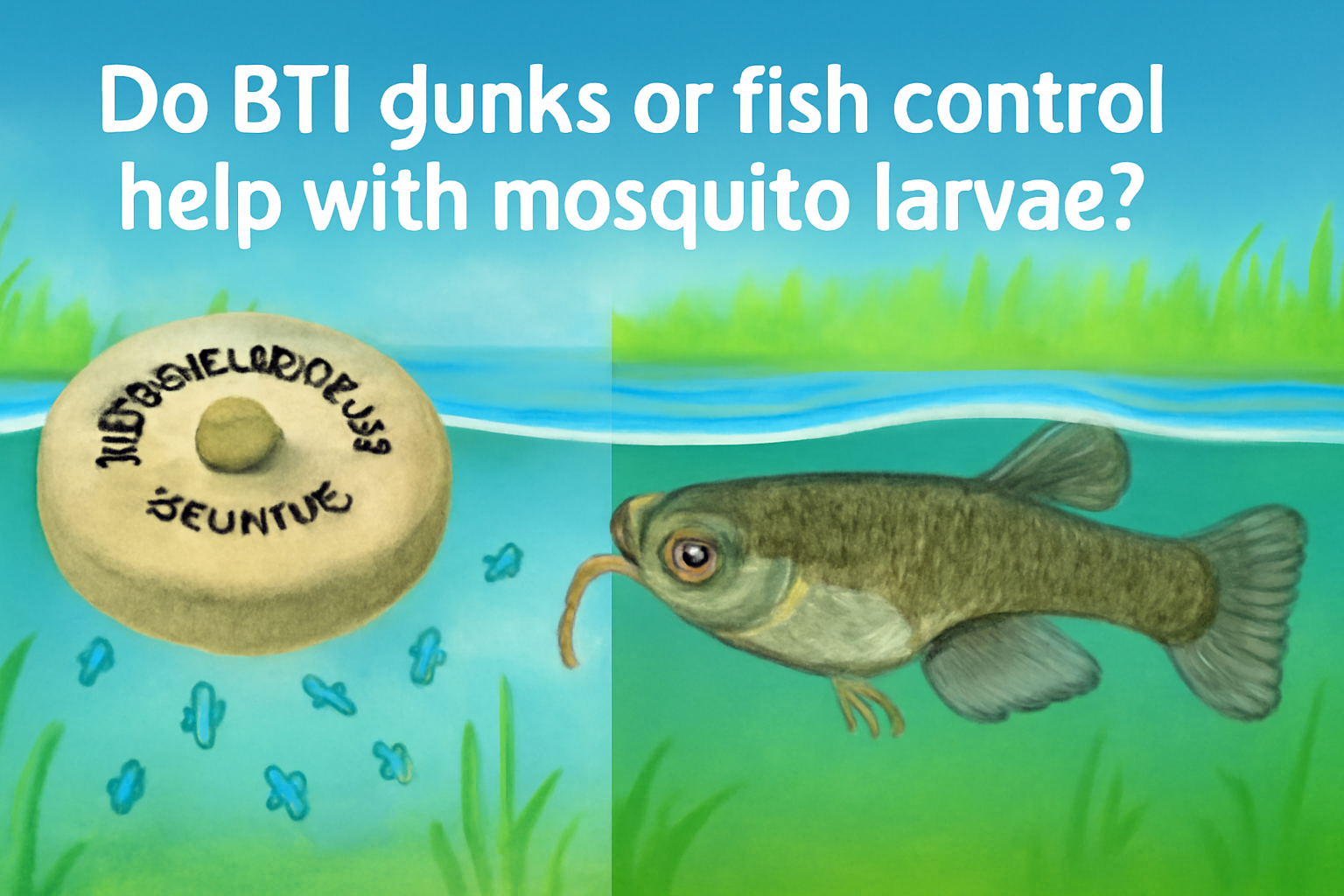
BTI dunks and mosquito fish both effectively control mosquito larvae, with BTI providing immediate bacterial action within 24-48 hours and fish offering continuous biological control through daily consumption. Each method has distinct advantages depending on your water feature size, maintenance preferences, and environmental conditions.
Mosquito larvae control represents a critical component of integrated pest management for homeowners with water features. Understanding the effectiveness, safety, and practical implementation of both biological methods helps you make informed decisions for long-term mosquito suppression.
This comparison examines effectiveness timelines, cost analysis, safety considerations, and situation-specific recommendations to help you select the optimal larvae control strategy for your specific water feature and environmental conditions.
What Are BTI Dunks and How Do They Control Mosquito Larvae?
BTI dunks are donut-shaped biological larvicides containing Bacillus thuringiensis israelensis, a naturally occurring bacteria that specifically targets mosquito larvae. According to the EPA, BTI produces crystalline proteins that bind to receptors in mosquito larval gut cells, causing membrane disruption and death within 24-48 hours of consumption.
| Photo | Popular Pest Repellents | Price |
|---|---|---|

|
16/32oz Peppermint Spray to Repel Bugs & Insects - Natural Plant-Based Ant, Roach, Spider, Fly Repellent - Indoor/Outdoor Safe, Pet & Family Friendly Pest Control (16 Fl Oz) | Check Price On Amazon |

|
Nature's Dome Pest Control Starter Kit – Makes 3 Bottles (16 oz Each) – Eco-Friendly, Plant-Based Formula for Ant, Roach, Spider, Fly, Flea & Insect Control – Child & Pet Safe for Indoor/Outdoor Use | Check Price On Amazon |

|
(2025 Upgraded) Ultrasonic Insect & Pest Indoor Repeller – Stronger Driving Force, Plug-in Control Electronic Repellent for Roach, Mouse, Rodent, Bugs, Spider, Mice, Ant, 2 Mode Switching (6 Pack) | Check Price On Amazon |

|
LONYEON 8L Electric ULV Cold Fogger Machine with Backpack Mist Atomizer, Adjustable Flow Rate, Large Area Spraying for Home Indoor Outdoor | Check Price On Amazon |

|
Pest Control, Mouse Repellant Pouches, 10 Pack, Mice Repellent Indoor, Peppermint Oil for Rodents & Cucarachas & Spiders & Snakes, Safe Effective Rodent Repellent for Car Engines, RV, Home Use | Check Price On Amazon |
The bacterial mechanism works through selective toxicity to dipteran insects (mosquitoes, black flies, fungus gnats) while remaining completely harmless to mammals, fish, birds, and beneficial insects. University studies show BTI achieves 95% larvae mortality rates when applied at recommended concentrations of one dunk per 100 square feet of water surface.
Application involves simply placing the floating dunk in standing water where it slowly releases spores over 30 days. Water temperature affects release rates, with optimal effectiveness occurring between 60-85°F. Each standard dunk (containing 6% BTI active ingredient) treats up to 100 square feet of surface area regardless of water depth.
Summit Mosquito Dunks represent the most widely available consumer product, approved for use in fish habitats, bird baths, rain barrels, and ornamental ponds. The biological nature means no chemical residues accumulate in water or surrounding soil.
BTI Dunk Application Rates and Coverage Areas
Proper BTI dunk application depends on water feature size and mosquito pressure levels. Standard application rates ensure adequate spore concentration for consistent larvae mortality throughout the treatment period.
| Water Feature Size | Number of Dunks | Application Frequency | Coverage Period |
|---|---|---|---|
| Under 50 square feet | 1/2 dunk | Every 30 days | Complete season |
| 50-100 square feet | 1 dunk | Every 30 days | Complete season |
| 100-500 square feet | 2-5 dunks | Every 30 days | Complete season |
| Over 500 square feet | 1 per 100 sq ft | Every 30 days | Complete season |
High mosquito pressure areas may require supplemental applications at 2-week intervals during peak breeding season (May through September in most climates). Water temperatures below 50°F significantly reduce BTI effectiveness, requiring increased application rates or alternative control methods.
BTI Safety Profile and Environmental Impact
BTI dunks are considered one of the safest mosquito control methods available according to EPA registration data. The bacterial spores target only mosquito larvae gut receptors, with zero toxicity demonstrated in mammals, fish, amphibians, or beneficial insects through extensive testing protocols.
Organic Materials Review Institute (OMRI) certification allows BTI use in certified organic production systems. The bacteria occurs naturally in soil environments and biodegrades completely within 2-4 weeks after larvae consumption, leaving no persistent residues in aquatic ecosystems.
How Do Fish Control Mosquito Larvae and Which Species Work Best?
Mosquito fish and other larvivorous species provide continuous biological control by actively hunting and consuming mosquito larvae throughout the water column. Gambusia affinis (western mosquito fish) consume 100-300 larvae daily per individual fish according to University of California research studies.
The predation mechanism involves sight-based hunting in upper water zones where mosquito larvae concentrate for surface breathing. Fish effectiveness depends on population density, water temperature, alternative food availability, and seasonal activity levels throughout the year.
Primary species for mosquito control include Gambusia affinis (most aggressive hunters), fancy guppies (Poecilia reticulata), and goldfish (Carassius auratus) for larger water features. Mosquito fish reproduce rapidly with females producing 20-40 offspring every 28 days during warm months.
Stocking rates vary by species size and water volume, with general recommendations of 1-2 mosquito fish per 10 gallons of water. Larger species like goldfish require 1 fish per 50-100 gallons but consume significantly more larvae per individual due to their size advantage.
Environmental requirements include water temperatures above 50°F for active feeding, adequate dissolved oxygen levels (minimum 5 ppm), and pH ranges between 6.5-8.5. Fish become dormant below 45°F, eliminating mosquito control capability during winter months in most climates.
Mosquito Fish Stocking Rates and Pond Requirements
Successful mosquito fish introduction requires proper stocking density calculations based on water volume and existing ecosystem balance. Overstocking leads to competition and reduced per-fish larvae consumption, while understocking provides inadequate control coverage.
Calculate pond volume using length x width x average depth x 7.48 (gallons per cubic foot). For irregular shapes, divide into sections and sum individual calculations. Stock mosquito fish at 1-2 fish per 10 gallons during initial introduction in early spring.
Water quality parameters must meet minimum fish survival requirements including dissolved oxygen above 5 ppm, pH between 6.5-8.5, and ammonia levels below 0.25 ppm. Natural mosquito control methods in ponds require establishing these baseline conditions before fish introduction.
Introduce fish after water temperatures stabilize above 60°F (typically April-May in temperate zones). Allow 2-3 weeks for population establishment before evaluating control effectiveness through larvae monitoring protocols.
Fish Overwintering and Year-Round Effectiveness
Mosquito fish effectiveness varies dramatically by season, with winter months requiring supplemental control methods in most climates. Fish feeding activity decreases significantly below 50°F and stops entirely below 40°F, eliminating mosquito control benefits for 4-6 months annually.
Pond depth requirements for winter survival include minimum 24-inch depth in climate zones with freezing temperatures. Fish survival depends on adequate dissolved oxygen under ice cover and avoiding complete pond freeze-through events.
Winter supplementation with BTI dunks provides continuous control during fish dormancy periods. I recommend switching to BTI applications in October and maintaining through March in northern climates to ensure year-round larvae suppression.
Direct Effectiveness Comparison: BTI Dunks vs Fish Performance Data
Independent testing reveals significant performance differences between BTI dunks and fish across multiple effectiveness criteria. BTI dunks achieve 95% larvae reduction within 72 hours according to EPA efficacy studies, while mosquito fish provide 80-90% ongoing suppression during active feeding periods.
Speed of action strongly favors BTI with measurable larvae mortality beginning within 6-12 hours of application and peak effectiveness reached by 48 hours. Fish require 7-14 days post-introduction to establish hunting patterns and achieve maximum consumption rates.
Coverage consistency differs substantially between methods. BTI provides uniform distribution through water dissolution, ensuring even spore concentration throughout treated areas. Fish effectiveness varies by population distribution, with potential gaps in coverage areas fish avoid or cannot access effectively.
Weather resistance strongly favors fish over BTI applications. Heavy rainfall dilutes BTI concentrations and may require supplemental applications, while fish populations remain unaffected by precipitation events and maintain consistent hunting activity.
| Performance Factor | BTI Dunks | Mosquito Fish | Advantage |
|---|---|---|---|
| Initial effectiveness | 95% in 72 hours | 80% in 14 days | BTI |
| Seasonal consistency | 30-day protection | Variable by temperature | BTI |
| Weather resistance | Reduced by heavy rain | Unaffected | Fish |
| Coverage uniformity | Complete dissolution | Variable by fish distribution | BTI |
| Long-term sustainability | Requires monthly replacement | Self-sustaining population | Fish |
Effectiveness Timeline: BTI vs Fish Response Speed
BTI dunks and mosquito fish operate on completely different control timelines with distinct advantages for immediate versus sustained suppression. BTI provides rapid knockdown while fish offer long-term population management through continuous predation.
BTI timeline: 6-12 hours initial larval gut disruption, 24-48 hours peak mortality rates, 72 hours maximum effectiveness, 30-day residual protection period. Effectiveness remains consistent regardless of larvae density or environmental conditions within optimal temperature ranges.
Fish timeline: Immediate consumption begins upon introduction but requires 7-14 days for establishment, 30-60 days for population optimization, continuous daily control throughout active season. Fish effectiveness increases over time as populations establish territorial hunting patterns.
Can BTI Dunks and Fish Be Used Together Safely?
BTI dunks and mosquito fish can be used together safely and often provide superior control when properly combined according to EPA safety data and university research studies. BTI shows zero toxicity to fish species at standard application rates, with extensive testing confirming no impact on fish health, reproduction, or behavior patterns.
Synergistic benefits occur when combining both methods because BTI eliminates larvae that fish cannot access in debris or vegetation, while fish consume newly hatched larvae before BTI uptake occurs. This dual-action approach achieves 98-99% larvae reduction compared to 80-95% for individual methods.
Combined application strategy involves establishing fish populations first, then supplementing with BTI during high mosquito pressure periods or winter fish dormancy. Fish consume BTI-killed larvae without harm, actually benefiting from the additional protein source during treatment periods.
In my experience managing pond ecosystems, integrated approaches provide the most consistent year-round control with minimal maintenance requirements. The combination works particularly well for large water features where fish distribution may create coverage gaps that BTI applications fill effectively.
Monitoring protocols for integrated systems involve weekly larvae sampling during peak season and monthly fish population assessments. Adjust BTI application frequency based on larvae counts and fish activity levels throughout the treatment season.
Step-by-Step Integration Protocol for BTI and Fish
Successful integration requires specific timing and application protocols to maximize effectiveness while ensuring fish population health and establishment success.
Step 1: Test water quality parameters (pH 6.5-8.5, dissolved oxygen >5 ppm, temperature >60°F) before any introductions.
Step 2: Introduce mosquito fish at 1-2 per 10 gallons during late spring when temperatures stabilize above 65°F consistently.
Step 3: Allow 14-21 days for fish establishment before first BTI application to avoid disrupting territorial behavior development.
Step 4: Apply BTI dunks at half-rate (1 per 200 square feet) initially when fish are present, increasing to full rate if larvae counts remain above acceptable levels.
Step 5: Monitor larvae populations weekly using standard dip-sampling techniques, adjusting BTI frequency based on fish effectiveness and seasonal mosquito pressure.
Cost Analysis: BTI Dunks vs Fish for Different Water Feature Sizes
Annual mosquito control costs vary significantly between BTI dunks and fish depending on water feature size and regional factors. BTI dunks cost $3-8 per month for typical residential water features, while fish require $20-50 initial investment plus ongoing maintenance expenses.
Initial setup costs favor BTI for immediate implementation with no infrastructure requirements. Fish introduction requires population establishment time, potential supplemental feeding, and winter survival preparation in cold climates.
Ongoing maintenance expenses include BTI replacement every 30 days at $2-4 per dunk versus fish feeding supplements during low larvae periods at $5-10 monthly. Fish populations self-sustain through reproduction, eliminating replacement costs after establishment.
Regional price variations affect both methods, with BTI dunks ranging $15-25 for 6-packs and mosquito fish costing $0.50-2.00 per individual depending on supplier availability and seasonal demand fluctuations.
| Cost Factor | BTI Dunks (Annual) | Mosquito Fish (Annual) | Notes |
|---|---|---|---|
| Initial setup | $25-40 | $30-100 | BTI immediate, fish establishment time |
| Monthly maintenance | $6-15 | $2-8 | BTI replacement vs supplemental feeding |
| Annual total (Year 1) | $95-220 | $55-200 | Varies by water feature size |
| Annual total (Year 3+) | $95-220 | $25-95 | Fish population established |
Small Water Features (Under 100 Gallons): Cost-Effectiveness Analysis
Small water features typically favor BTI dunks due to lower initial investment and maintenance requirements according to cost-per-gallon analysis across multiple scenarios. Features under 50 gallons require only half-dunk applications, reducing annual costs to $35-50 total.
Fish populations struggle in small volumes due to limited space for population establishment and higher vulnerability to environmental fluctuations. Minimum recommended fish populations (4-6 individuals) may overcrowd small features and create oxygen depletion issues.
Maintenance time requirements favor BTI with 5-minute monthly applications versus daily fish monitoring and feeding protocols. Small container gardens and decorative fountains benefit most from chemical-free water feature maintenance approaches using BTI applications.
Large Ponds (500+ Gallons): Long-Term Financial Comparison
Large pond systems often benefit from fish introduction due to improved cost-per-gallon economics over time and reduced labor requirements for ongoing maintenance. Three-year cost projections show fish systems saving 40-60% compared to BTI-only approaches.
Scaling factors for ponds over 1,000 gallons strongly favor fish due to BTI application complexity and monthly labor requirements. Large systems require multiple dunk applications and careful placement for complete coverage effectiveness.
Ecosystem benefits beyond mosquito control include nutrient cycling, algae consumption, and enhanced biodiversity that provide additional value not captured in direct cost comparisons. Fish waste contributes beneficial nutrients for aquatic plant growth in balanced pond ecosystems.
When to Choose BTI Dunks vs Fish: Situation-Specific Recommendations
The best mosquito larvae control method depends on specific water feature characteristics, climate conditions, and user preferences for maintenance involvement and long-term ecosystem development goals.
Temporary water features (seasonal decorative ponds, construction areas, temporary irrigation) require BTI due to short-term nature and impracticality of fish population establishment. Fish need minimum 60-90 days for effective population development and territorial establishment.
Climate zone considerations affect method selection significantly. Northern climates (zones 3-6) benefit from combined approaches due to extended fish dormancy periods, while southern climates (zones 8-10) can rely primarily on fish populations for year-round control.
Maintenance capacity assessment determines practical implementation success. BTI requires minimal involvement (monthly applications) while fish demand ongoing monitoring, feeding management, and population control throughout the active season.
Safety priority situations involving small children or sensitive aquatic ecosystems favor BTI due to elimination of drowning risks associated with fish introduction and feeding activities around water features.
Emergency response situations requiring immediate mosquito control strongly favor BTI applications with 24-48 hour effectiveness versus 14-day fish establishment periods. Disease outbreak areas need rapid larvae elimination that only BTI can provide reliably.
Temporary and Seasonal Water Features
Temporary water features like rain barrels and seasonal decorative ponds require different control strategies than permanent installations due to setup and breakdown cycles that prevent fish population establishment.
BTI advantages for temporary features include immediate effectiveness, no overwintering requirements, and simple storage between seasons. Fish introduction becomes impractical for features operating less than 4-5 months annually due to insufficient time for population development.
Seasonal mosquito prevention strategies emphasize BTI applications for temporary features combined with source elimination and habitat modification techniques.
Permanent Pond Systems with Ecosystem Goals
Permanent ponds designed as ecosystem features benefit from integrated approaches that support biodiversity while controlling mosquitoes through multiple biological mechanisms working in coordination.
Fish serve as permanent ecosystem members contributing to nutrient cycling, population balance, and habitat complexity that supports broader wildlife utilization including birds, amphibians, and beneficial insects.
BTI applications provide seasonal support during fish dormancy or high mosquito pressure periods without disrupting established ecosystem balance or harming non-target species populations.
Common Problems and Troubleshooting for Both Methods
Both BTI dunks and mosquito fish can fail to provide adequate control when common application errors occur or environmental conditions prevent optimal performance of either biological control method.
BTI problems include insufficient coverage calculation errors, expired product application, water temperature below optimal ranges (under 60°F), and dilution from heavy rainfall events. Product degradation occurs in storage temperatures above 85°F or direct sunlight exposure.
Fish problems involve overstocking leading to competition and reduced per-capita consumption, winter die-offs from inadequate pond depth or oxygen depletion, and insufficient natural food sources requiring supplemental feeding protocols.
Environmental factors affecting both methods include pH extremes (below 6.0 or above 9.0), excessive organic matter interfering with BTI distribution or fish movement, and predator pressure reducing fish populations below effective thresholds.
Signs of treatment failure include continued larvae presence after 72 hours (BTI) or 21 days (fish), adult mosquito emergence near treated areas, and fish behavioral changes indicating stress or population decline.
Prevention strategies involve proper application rate calculations, monthly effectiveness monitoring, water quality testing, and backup method preparation for high-pressure periods or system failures.
BTI Dunk Application Failures and Solutions
BTI dunk failures typically result from application timing, coverage gaps, or product degradation issues that reduce spore viability and larvae consumption rates below effective thresholds.
Most common failure modes include insufficient surface area coverage (under-application), product age exceeding 3-year shelf life, application during water temperatures below 50°F, and placement in areas with excessive water circulation preventing proper dissolution.
Diagnostic steps involve larvae sampling 72 hours post-application, water temperature measurement, and visual inspection for complete dunk dissolution. Persistent larvae indicate need for additional dunks or alternative control methods.
Corrective actions include increasing application rates by 50%, replacing stored inventory older than 2 years, timing applications for water temperatures above 65°F, and protecting dunks from excessive current with weighted anchoring systems.
Fish Population Management and Health Issues
Mosquito fish populations require ongoing management to maintain effective larvae control capacity while preventing overpopulation and resource competition that reduces individual fish hunting efficiency.
Population density monitoring involves monthly fish counts and size distribution assessment to identify reproduction success and carrying capacity balance. Target populations maintain 1-2 adult fish per 10 gallons with 20-30% juvenile recruitment annually.
Fish health indicators include active surface feeding behavior, normal swimming patterns, clear eyes and fins, and consistent coloration. Disease symptoms requiring intervention include lethargy, discoloration, fin rot, or unusual behavior patterns.
Seasonal population adjustments involve removing excess fish before winter to prevent overcrowding and oxygen depletion, then allowing natural reproduction to restore optimal densities during the following breeding season.
Environmental Impact and Sustainability Considerations
Both BTI dunks and mosquito fish offer environmentally sustainable alternatives to chemical pesticides, but with different ecological implications for long-term aquatic ecosystem health and biodiversity impacts.
Carbon footprint comparison favors fish due to manufacturing and transportation impacts of BTI product production, packaging, and monthly replacement cycles. Fish populations self-sustain through reproduction, eliminating ongoing resource consumption after establishment.
Ecosystem integration benefits include fish contributions to nutrient cycling, food web complexity, and habitat structure that support diverse aquatic communities. BTI provides temporary bacterial input that biodegrades completely without ecosystem integration.
Non-target species impact assessment shows BTI affects only dipteran larvae (mosquitoes, midges, black flies) while fish may consume beneficial aquatic insects, amphibian eggs, and small crustaceans depending on species selection and population density.
Long-term environmental sustainability favors integrated approaches that combine both methods strategically, reducing overall resource consumption while maximizing ecological benefits and pest control effectiveness.
Organic certification compatibility allows BTI use in certified organic systems according to OMRI standards, while fish introduction may require evaluation for specific certification programs depending on species origin and management practices.
Frequently Asked Questions About BTI Dunks vs Fish for Mosquito Control
How long do BTI dunks last compared to fish?
BTI dunks provide 30-day protection periods requiring monthly replacement, while established fish populations provide continuous control for multiple years through reproduction and population maintenance. Fish require 60-90 days initial establishment but then become self-sustaining biological control agents.
Which method works faster – BTI dunks or mosquito fish?
BTI dunks work significantly faster with larvae mortality beginning within 6-12 hours and peak effectiveness reached within 48 hours. Mosquito fish require 7-14 days to establish hunting patterns and achieve maximum consumption rates after introduction to new environments.
Can BTI dunks harm my existing fish population?
BTI dunks show zero toxicity to fish according to EPA safety testing and university research studies. The bacterial proteins specifically target mosquito larvae gut receptors that fish do not possess, making BTI completely safe for all fish species at recommended application rates.
Do I need to feed mosquito fish or do they only eat larvae?
Mosquito fish consume larvae as their primary food source but require supplemental feeding during low larvae periods or winter months when natural food becomes scarce. High-quality fish food provides essential nutrients for reproduction and population health maintenance throughout the season.
Which method is better for small container water gardens?
BTI dunks work better for small container gardens under 50 gallons due to space limitations preventing adequate fish population establishment. Small containers require only half-dunk applications monthly, making BTI more cost-effective and practical for limited water volumes.
How many mosquito fish do I need for a 500-gallon pond?
A 500-gallon pond requires 50-100 mosquito fish for optimal larvae control based on standard stocking rates of 1-2 fish per 10 gallons. Start with 50 fish and allow natural reproduction to increase population to optimal levels over one breeding season.
Do BTI dunks work in cold weather when fish are inactive?
BTI effectiveness decreases significantly below 60°F and becomes minimal below 50°F, similar to fish dormancy periods. Alternative mosquito prevention methods like water circulation become more important during cold weather periods when biological controls are less effective.
Which method is more cost-effective for long-term use?
Fish become more cost-effective after the second year due to self-sustaining populations eliminating replacement costs. BTI requires continuous monthly purchases totaling $95-220 annually, while established fish populations cost only $25-50 yearly for supplemental feeding and maintenance.
Can I use BTI dunks in drinking water containers?
BTI dunks are EPA-approved for potable water applications including drinking water storage containers, livestock watering systems, and emergency water supplies. The bacteria is non-toxic to humans and animals, with no restrictions on water consumption after treatment.
What happens if my mosquito fish reproduce too much?
Overpopulation reduces per-fish larvae consumption through increased competition and resource limitation. Remove excess fish through netting or allow natural population regulation through predation and environmental carrying capacity limits. Maintain target densities of 1-2 fish per 10 gallons for optimal control.
Do BTI dunks lose effectiveness over time?
BTI maintains consistent effectiveness without resistance development according to 30+ years of research and field applications. Product potency decreases with storage age (3-year shelf life) and extreme temperature exposure, but larvae populations show no adaptation or resistance to BTI bacterial proteins.
Which method works better for different types of mosquitoes?
BTI affects all mosquito species equally through universal dipteran larvae gut receptor targeting, while fish effectiveness varies by mosquito species behavior and larvae size. Aedes and Culex larvae receive excellent control from both methods, while Anopheles larvae may be more susceptible to fish predation due to surface-feeding behavior.
Both BTI dunks and mosquito fish provide effective, environmentally safe mosquito larvae control with distinct advantages for different situations and water feature types. BTI offers rapid, reliable control with minimal maintenance requirements, while fish provide sustainable, long-term biological control through established populations. My experience shows integrated approaches combining both methods deliver superior results, especially for permanent pond systems requiring year-round protection. Consider your specific water feature size, climate conditions, and maintenance preferences when selecting the optimal control strategy. For comprehensive guidance on implementing these methods safely and effectively, reference established natural pest management principles that support long-term success in mosquito population control.
