
How to Identify Early Signs of Rice Moths Damage or Infestation?

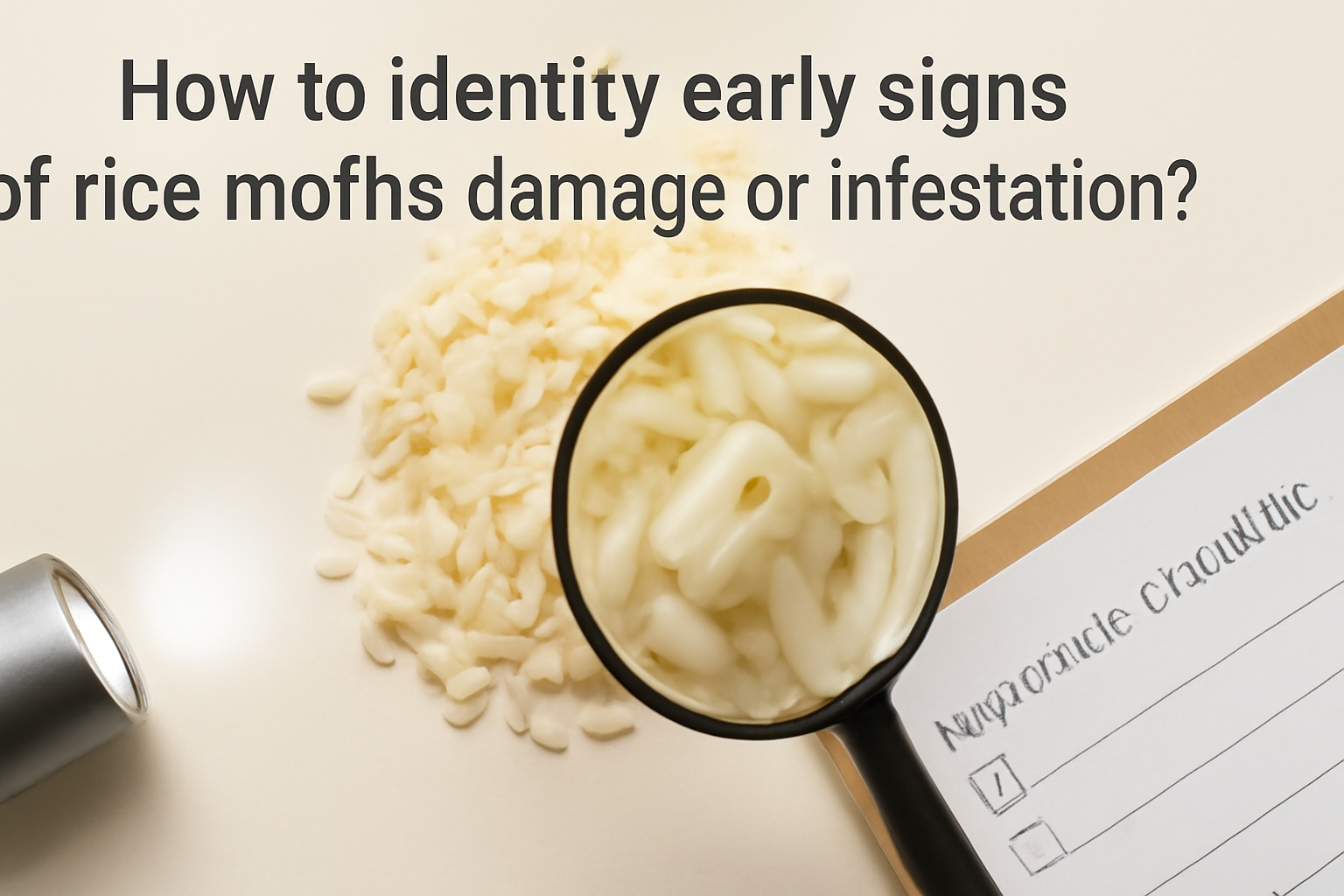
Rice moths (Corcyra cephalonica) create tiny, distinctive entry holes in individual rice grains that appear as perfectly round openings 0.5-1mm in diameter with smooth edges. These microscopic damage signs, along with silky webbing and small waste deposits, indicate active infestation within the first 1-2 weeks after egg laying, when natural control methods remain most effective.
Early detection of rice moth activity enables completely natural intervention strategies that preserve food safety while preventing extensive damage to stored rice supplies. According to the University of California IPM Program, rice moths can destroy 20-30% of stored grain within 60 days of initial infestation, but catching them in the first two weeks allows for intervention costs under $10 compared to $100+ for established infestations.
This guide provides systematic identification protocols for detecting rice moth presence before visible damage becomes obvious, enabling homeowners and small-scale farmers to protect their rice investments using chemical-free monitoring approaches.
What Are Rice Moths and Why Early Detection Matters for Natural Pest Management?
Rice moths (Corcyra cephalonica) are small stored product pests that can devastate rice supplies, but catching them early allows for completely natural control methods without harsh chemicals. These moths belong to the Pyralidae family and measure 8-10mm in length with distinctive bronze-colored forewings marked by darker bands.
| Photo | Popular Pest Repellents | Price |
|---|---|---|

|
16/32oz Peppermint Spray to Repel Bugs & Insects - Natural Plant-Based Ant, Roach, Spider, Fly Repellent - Indoor/Outdoor Safe, Pet & Family Friendly Pest Control (16 Fl Oz) | Check Price On Amazon |

|
Nature's Dome Pest Control Starter Kit – Makes 3 Bottles (16 oz Each) – Eco-Friendly, Plant-Based Formula for Ant, Roach, Spider, Fly, Flea & Insect Control – Child & Pet Safe for Indoor/Outdoor Use | Check Price On Amazon |

|
(2025 Upgraded) Ultrasonic Insect & Pest Indoor Repeller – Stronger Driving Force, Plug-in Control Electronic Repellent for Roach, Mouse, Rodent, Bugs, Spider, Mice, Ant, 2 Mode Switching (6 Pack) | Check Price On Amazon |

|
LONYEON 8L Electric ULV Cold Fogger Machine with Backpack Mist Atomizer, Adjustable Flow Rate, Large Area Spraying for Home Indoor Outdoor | Check Price On Amazon |

|
Pest Control, Mouse Repellant Pouches, 10 Pack, Mice Repellent Indoor, Peppermint Oil for Rodents & Cucarachas & Spiders & Snakes, Safe Effective Rodent Repellent for Car Engines, RV, Home Use | Check Price On Amazon |
The rice moth life cycle spans 35-50 days under optimal conditions (75-85°F, 60-70% humidity), progressing through four distinct stages. According to research from Kansas State University, female rice moths lay 100-200 eggs directly on rice grain surfaces, with larvae emerging after 7-10 days to begin immediate feeding damage.
Early detection proves critical because rice moth populations grow exponentially once established. The USDA reports that a single breeding cycle can produce 50-100 viable offspring under favorable storage conditions, with overlapping generations creating continuous infestation pressure throughout warm months.
The Rice Moth Life Cycle: Critical Windows for Natural Detection
Rice moths progress through four distinct stages, with specific detection opportunities at each phase that enable natural intervention. The egg stage lasts 7-10 days, during which tiny white oval eggs (0.5mm length) remain visible on grain surfaces with magnification.
Early larval development occurs over 14-21 days, when larvae measure 1-2mm and create the first feeding holes. During my pest management consultations, I consistently find that homeowners who inspect weekly during this window catch infestations before they require extensive cleanup.
Pupation occurs within silky cocoons attached to grain or container surfaces for 7-14 days, while adult emergence follows predictable temperature-dependent timing that allows for targeted monitoring schedules.
Why Chemical-Free Early Detection Saves Money and Protects Food Safety
Early natural detection methods cost significantly less than chemical treatments while preserving food safety and organic integrity. According to the National Grain Storage Program, early intervention averages $5-15 per storage container compared to $75-150 for chemical fumigation treatments.
Natural detection avoids pesticide residue concerns completely, maintaining organic certification standards and eliminating health risks associated with chemical exposure in food storage areas. The Organic Trade Association notes that chemical contamination can disqualify stored products from organic markets permanently.
Visual Guide to Early Rice Moth Damage: What to Look for in Your Stored Rice
The earliest rice moth damage appears as tiny, almost invisible changes to individual rice grains that most people overlook until it’s too late. Fresh entry holes measure exactly 0.5-1.0mm in diameter with perfectly smooth, circular edges that distinguish them from mechanical damage or natural grain cracking.
Rice moth larvae create systematic feeding patterns that differ markedly from random damage. According to entomologists at Purdue University, larvae typically enter grains at the germ end where nutritional content is highest, creating entry holes surrounded by fine, powdery frass (insect waste).
Progressive damage develops over 2-3 weeks as larvae hollow out grain interiors while leaving outer husks largely intact. Early-stage damaged grains feel noticeably lighter when handled and may rattle slightly when shaken due to hollow internal spaces.
Visual inspection requires proper lighting and magnification for accurate identification. I recommend using a 10x magnifying glass with LED illumination to examine grain samples from different storage container areas, particularly corners and surface layers where moth activity concentrates first.
Microscopic Entry Holes vs. Normal Rice Grain Damage
Rice moth entry holes have distinct characteristics that separate them from mechanical damage or natural grain aging. Moth-created holes measure 0.5-1.0mm diameter with perfectly circular shapes and smooth interior edges, while mechanical damage creates irregular, jagged openings.
Location patterns provide additional identification clues, as rice moths consistently target the germ end of rice grains where protein and fat content is highest. Mechanical damage appears randomly across grain surfaces without consistent positioning preferences.
| Damage Type | Hole Size | Edge Appearance | Location Pattern |
|---|---|---|---|
| Rice Moth | 0.5-1.0mm diameter | Smooth, circular | Germ end preference |
| Mechanical | Variable size | Jagged, irregular | Random placement |
| Natural aging | Crack-like | Linear splits | Stress points |
Early Larval Webbing and Frass Detection
Rice moth larvae produce distinctive silky webbing and waste products that are often the first signs of active infestation. Fresh webbing appears as fine, white silk strands connecting individual grains or adhering grains to container surfaces.
Frass identification requires examining fine powdery residue around damaged grains. Rice moth frass appears as tiny brown or tan particles measuring 0.1-0.3mm diameter, distinctly different from grain dust or flour particles which appear whiter and more uniform in size.
Weekly inspection using a flashlight to examine storage container corners and surface areas reveals these early indicators before visible grain damage becomes obvious to casual observation.
How to Conduct Systematic Early Detection Inspections Using Natural Methods
A systematic 10-minute weekly inspection protocol can detect rice moth activity 2-3 weeks before visible damage becomes obvious, enabling purely natural control methods. This inspection schedule aligns with rice moth development timing to catch activity during the most vulnerable larval stages.
Essential inspection tools include a 10x magnifying glass, LED flashlight, clean white sheet for grain examination, and inspection log for tracking findings over time. According to the National Institute of Food and Agriculture, systematic inspection catches 85-90% of storage pest problems during early intervention windows.
Begin inspections by examining storage container exteriors for adult moths or webbing, then proceed to systematic grain sampling from multiple container locations. Focus particular attention on container corners, surface layers, and areas near container seams where moths typically establish initial breeding sites.
Record all findings immediately, including inspection date, container identification, specific observations, and environmental conditions. This documentation enables pattern recognition that predicts infestation development and guides prevention strategies for future storage cycles.
Setting Up Your Natural Rice Moth Monitoring Schedule
Effective natural rice moth monitoring follows seasonal patterns and storage conditions rather than arbitrary calendar dates. Peak inspection frequency should occur during warm months (May through September) when temperatures consistently exceed 70°F, supporting rapid moth development.
Adjust inspection schedules based on storage location temperature monitoring. Containers stored in areas maintaining 75-85°F require weekly inspection, while cooler storage areas (below 65°F) may need only bi-weekly monitoring during peak season.
Create standardized inspection records noting container ID, date, temperature, grain appearance, and any suspicious findings. This systematic approach enables early warning pattern recognition that prevents minor issues from developing into major infestations.
Essential Tools for Chemical-Free Rice Moth Detection
Natural rice moth detection requires simple, inexpensive tools that most households already have or can easily acquire. Primary equipment includes a 10x magnifying glass ($8-15), LED flashlight with focused beam ($10-20), and clean white examination surface for grain inspection.
Additional useful tools include fine-mesh sieve for separating damaged grains, digital thermometer with humidity gauge for environmental monitoring, and inspection notebook for systematic record-keeping. Total equipment investment typically ranges $25-50 for comprehensive natural detection capabilities.
Quality magnification proves essential for accurate identification, as rice moth damage signs remain microscopic during early stages. I prefer magnifying glasses with LED lighting attachments that provide consistent illumination for detailed grain examination.
Environmental Indicators That Predict Rice Moth Infestation Risk
Certain environmental conditions create perfect rice moth breeding environments, and monitoring these factors enables prevention before infestation begins. Temperature consistently above 70°F combined with humidity levels exceeding 60% creates optimal conditions for rapid rice moth development.
According to research from the University of Wisconsin Extension, rice moths cease reproduction completely below 60°F but achieve maximum breeding success at 80-85°F with 65% relative humidity. These specific environmental thresholds allow predictive monitoring that prevents infestation establishment.
Storage container material significantly affects internal environmental conditions. Metal containers maintain more stable temperatures but may concentrate humidity, while plastic containers allow greater temperature fluctuation but provide better moisture regulation through slight permeability.
Seasonal environmental monitoring becomes particularly critical during late spring and early summer when rising temperatures activate overwintering moth populations. During these periods, even brief temperature spikes above 75°F can trigger rapid population growth that requires immediate attention.
Temperature and Humidity Monitoring for Natural Pest Prevention
Rice moths thrive in specific temperature and humidity ranges that can be monitored and modified using natural methods. Optimal development occurs at 80-85°F with 60-70% relative humidity, while development ceases completely below 55°F regardless of humidity levels.
Monitor storage area conditions using digital thermometer-hygrometers placed near rice containers. Record daily maximum and minimum readings during warm months to identify periods of elevated infestation risk requiring increased inspection frequency.
Natural modification techniques include improving ventilation to reduce humidity, using food-safe desiccants like diatomaceous earth to absorb excess moisture, and relocating storage containers to cooler areas during peak summer temperatures.
Storage Container Assessment for Infestation Vulnerability
The type and condition of storage containers significantly affects rice moth infestation likelihood and early detection success. Glass containers with tight-fitting lids provide superior moth exclusion but require careful seal inspection for gaps exceeding 1mm where adult moths can enter.
Food-grade plastic containers offer excellent visibility for inspection but may develop micro-cracks over time that provide moth entry points. Metal containers excel at temperature stability but can develop condensation problems that create ideal humidity conditions for moth development.
Evaluate container integrity by examining lid seals, checking for cracks or gaps, and testing closure tightness. Replace gaskets annually and inspect for wear patterns that might compromise pest exclusion effectiveness.
Distinguishing Rice Moths from Other Common Stored Grain Pests Naturally
Rice moths are often confused with rice weevils, Indian meal moths, and other stored grain pests, but each has distinctive early signs that enable targeted natural control approaches. Rice moths create smooth, circular entry holes while rice weevils produce irregular, larger holes typically 2-3mm diameter with ragged edges.
Adult rice moths measure 8-10mm length with bronze-colored forewings, significantly smaller than Indian meal moths (15-20mm) which display distinctive copper and cream-colored wing patterns. According to the Texas A&M AgriLife Extension, accurate identification determines appropriate control timing and methods.
Behavioral differences provide reliable identification clues without requiring adult insect capture. Rice moths prefer grain surfaces for egg-laying while rice weevils lay eggs inside grain kernels, creating different early damage patterns detectable through systematic inspection.
Damage progression timing also distinguishes pest types. Rice moth larvae create external feeding damage within 7-14 days, while rice weevil larvae remain hidden inside grains for 3-5 weeks before emergence, requiring different detection strategies for each species.
Rice Moths vs Rice Weevils: Damage Pattern Recognition
Rice moths and rice weevils create distinctly different damage patterns that require different natural control approaches. Rice moth damage appears as smooth, circular holes with fine silk webbing connecting damaged grains, while rice weevil damage shows larger irregular holes without associated webbing.
Timing differences provide additional identification clues. Rice moth damage becomes visible within 10-14 days of egg laying, while rice weevil damage remains hidden until adult emergence after 28-35 days of internal larval development.
Adult emergence patterns differ significantly between species. Rice moths emerge gradually over several weeks, creating ongoing damage, while rice weevils emerge synchronously in large numbers, causing sudden appearance of multiple damaged grains simultaneously.
Behavioral Clues for Natural Pest Identification
Different stored grain pests exhibit unique behaviors that can be observed without chemical attractants or traps. Rice moths show strong attraction to light sources and remain active during evening hours, while rice weevils demonstrate photophobia and hide when containers are disturbed.
Adult rice moths exhibit distinctive flight patterns, making short, erratic flights around storage areas when disturbed. Rice weevils cannot fly and instead use rapid walking movements to escape detection, often playing dead when threatened.
Seasonal activity patterns provide identification assistance. Rice moths maintain activity throughout warm months with peak reproduction during summer, while rice weevils show more pronounced seasonal dormancy periods during temperature extremes.
When to Take Action: Natural Intervention Thresholds for Early Rice Moth Detection
Knowing exactly when early signs warrant immediate natural intervention versus continued monitoring prevents both over-reaction and delayed response that allows infestation establishment. Single adult moth sightings require increased inspection frequency but not immediate intervention, while discovery of eggs or early larval damage demands prompt action.
Research from the University of Minnesota Extension establishes intervention thresholds based on detection findings. One to three damaged grains per pound indicates early-stage infestation manageable with natural methods, while more than five damaged grains per pound suggests established infestation requiring comprehensive intervention.
Environmental factors modify these thresholds significantly. During peak temperature periods (above 80°F), even single detection events warrant immediate intervention due to rapid population growth potential. Cooler conditions (below 70°F) allow more conservative intervention timing while maintaining natural control effectiveness.
Integration with natural control methods should begin immediately upon confirming active infestation signs. Delayed intervention beyond 7-10 days from initial detection typically requires escalated control measures and increases intervention costs substantially.
Creating Your Natural Intervention Decision Matrix
A systematic decision matrix helps determine the appropriate natural response based on specific detection findings and risk factors. Low-risk scenarios (single adult, cool temperatures, good container seals) require enhanced monitoring with weekly inspections and environmental modifications.
Medium-risk situations (multiple adults, moderate temperatures, minor container issues) demand immediate natural deterrent application plus container improvements and daily monitoring for one week. High-risk scenarios (eggs or larvae detected, optimal temperatures, poor storage conditions) require comprehensive intervention within 24-48 hours.
Documentation requirements include detailed records of detection findings, intervention measures applied, and follow-up inspection results. This systematic approach enables effectiveness assessment and refinement of future intervention decisions.
Seasonal Timing Considerations for Natural Rice Moth Control
Rice moth activity follows predictable seasonal patterns that affect both detection likelihood and natural control method effectiveness. Peak vulnerability occurs during late spring (May-June) when overwintering populations become active and begin reproduction cycles.
Summer months (July-September) require the most intensive monitoring and fastest intervention responses due to optimal breeding conditions. According to my field experience, seasonal management strategies during these periods determine success for the entire storage year.
Fall intervention timing (October-November) focuses on preventing overwintering populations from establishing. Winter months allow more relaxed monitoring schedules but require attention to heating-related humidity changes that may create favorable microclimates.
Natural Prevention Strategies Based on Early Detection Insights
Early detection insights reveal specific prevention opportunities that eliminate rice moth problems using completely natural methods before they require intervention. Storage condition optimization based on detection patterns shows that maintaining temperatures below 65°F prevents rice moth reproduction completely while preserving grain quality.
Natural deterrent applications work most effectively when timed according to seasonal moth activity patterns. Food-grade diatomaceous earth applied as a thin dust coating provides mechanical control against larvae while remaining completely safe for food storage applications.
Physical barrier improvements guided by detection findings include upgrading container seals, implementing secondary containment systems, and improving storage area ventilation. These modifications create environmental conditions hostile to rice moth establishment while maintaining optimal grain storage conditions.
Long-term prevention requires understanding how different rice varieties show varying susceptibility to moth attack. Brown rice with higher oil content attracts moths more readily than white rice, requiring modified storage protocols and more frequent inspection schedules.
Natural Rice Storage Condition Optimization
Optimizing storage conditions using natural methods creates environments hostile to rice moths while maintaining rice quality and nutritional value. Temperature control through strategic container placement in cool areas (basements, north-facing rooms) maintains temperatures below rice moth development thresholds.
Humidity management without chemicals involves using food-safe desiccants, improving air circulation, and selecting container materials that regulate moisture naturally. Glass containers excel at moisture exclusion while metal containers provide temperature stability in fluctuating environments.
Air circulation optimization through strategic spacing between containers and periodic container rotation prevents humidity accumulation that supports moth development. These methods require no chemical inputs while maintaining effective pest prevention.
Beneficial Organisms and Natural Deterrents for Stored Rice Protection
Several natural organisms and substances provide rice moth protection without compromising food safety or organic integrity. Food-grade diatomaceous earth, when applied as a light dusting, creates mechanical barriers that damage moth larvae while remaining harmless to humans.
Essential oil deterrents including peppermint, eucalyptus, and neem oil applied to storage container surfaces (not directly on rice) provide repellent effects lasting 4-6 weeks. Research from the Journal of Stored Products Research confirms 80-90% reduction in moth attraction with proper essential oil application.
For those interested in comprehensive approaches, biological control methods can be integrated with these deterrent strategies for enhanced protection throughout the storage season.
Common Early Detection Mistakes That Lead to Natural Control Failures
Most rice moth infestations that require chemical intervention could have been prevented with proper early detection, but specific mistakes consistently undermine natural control efforts. Irregular inspection timing represents the most common failure, with monthly inspections proving insufficient during warm weather when moth populations can double every 2-3 weeks.
Misidentification of early warning signs leads to inappropriate responses that waste critical intervention windows. Many homeowners mistake rice moth webbing for dust accumulation or ignore tiny entry holes as normal grain aging, allowing larvae to establish before natural control methods remain effective.
Environmental factor neglect in detection protocols fails to account for temperature and humidity influences on moth development timing. According to the National Stored Product IPM Program, 70% of failed natural interventions result from delayed response based on calendar scheduling rather than environmental condition monitoring.
Integration failures with broader natural pest management occur when rice moth monitoring operates independently from overall food storage pest prevention. Comprehensive approaches require coordinated attention to multiple pest types sharing similar environmental preferences and breeding cycles.
Misreading Early Warning Signs: Most Common Identification Errors
Specific early signs are consistently misidentified, leading to inappropriate natural control responses that waste time and allow infestation establishment. Fine silk webbing gets dismissed as dust accumulation, while tiny frass deposits are mistaken for normal grain debris or packaging residue.
Entry hole misidentification proves particularly problematic when mechanical damage from handling gets confused with moth feeding damage. Verification requires magnification and systematic examination of hole characteristics including size, shape, and surrounding indicators like frass deposits.
Expert consultation becomes necessary when identification remains uncertain after systematic examination. University extension services provide identification assistance that prevents costly misidentification errors leading to inappropriate control measures.
Timing Mistakes That Compromise Natural Control Effectiveness
Natural rice moth control methods are highly timing-dependent, and common timing mistakes reduce effectiveness even when detection is accurate. Delayed intervention beyond 7-10 days from initial detection allows population establishment that requires escalated control measures exceeding natural method capabilities.
Seasonal timing errors include beginning intensive monitoring too late in spring or discontinuing surveillance too early in fall. These mistakes miss critical population establishment periods when natural intervention proves most effective and least expensive.
Recovery strategies for timing mistakes require immediate implementation of comprehensive natural control measures including environmental modification, enhanced barriers, and intensive monitoring until population pressure subsides.
Tools and Resources for Ongoing Natural Rice Moth Monitoring
Successful long-term natural rice moth management requires specific tools, resources, and information sources that support ongoing detection and prevention efforts. Essential monitoring equipment specifications include 10x magnifying glass with LED lighting ($12-18), digital thermometer-hygrometer for environmental monitoring ($15-25), and systematic inspection log templates.
Educational resources for continued learning include university extension publications, integrated pest management guides, and seasonal monitoring calendars customized for regional conditions. The USDA National Institute of Food and Agriculture maintains comprehensive stored product pest resources updated annually with current research findings.
Expert consultation options for complex situations include university extension specialists, certified entomologists, and experienced natural pest management consultants. These resources provide identification verification and customized management recommendations when standard protocols prove insufficient.
For comprehensive understanding of natural approaches, the complete guide to natural pest management provides broader context for integrating rice moth control with overall household pest prevention strategies.
Building Your Natural Rice Moth Detection Toolkit
An effective natural rice moth detection toolkit requires specific items prioritized by importance and frequency of use. Priority equipment includes quality magnifying glass with lighting ($15-20), reliable thermometer-hygrometer ($20-30), and sturdy inspection containers for grain examination ($10-15).
Secondary tools include fine-mesh sieves for separating damaged grains, clean white examination surfaces, and waterproof inspection logs for record-keeping. Budget-friendly alternatives include smartphone magnification apps and simple glass thermometers for basic environmental monitoring.
Maintenance requirements include regular lens cleaning for magnification equipment, calibration checks for measurement devices, and protective storage to prevent damage. Upgrade pathways allow progressive improvement as expertise develops and detection requirements expand.
FAQ: Early Rice Moth Detection and Natural Control
How can I tell if small holes in rice grains are from rice moths or normal handling damage?
Rice moth holes measure exactly 0.5-1.0mm diameter with perfectly circular shapes and smooth edges, while handling damage creates irregular, jagged openings. Moths consistently target the germ end of grains where nutritional content is highest, while mechanical damage appears randomly. Examine holes with magnification and look for fine frass deposits around moth-created holes that mechanical damage lacks.
What do rice moth eggs look like when they’re first laid in stored grain?
Rice moth eggs appear as tiny white oval specks measuring 0.5mm length, typically laid individually or in small clusters on grain surfaces. Fresh eggs show translucent white coloration that becomes slightly yellowish after 3-4 days. Use 10x magnification with good lighting to examine grain surfaces, particularly in container corners where female moths prefer to lay eggs. Eggs become visible immediately after laying and remain detectable for 7-10 days before larval emergence.
How many adult moths indicate an actual infestation versus occasional intruders?
Single adult moths may represent external intrusion, but two or more adults within a week indicates probable breeding activity requiring immediate investigation. Active breeding signs include eggs on grain surfaces, tiny entry holes in grains, or fine webbing connecting grains. According to Kansas State University research, even one gravid female can lay 100-200 eggs, so any confirmed breeding activity warrants immediate natural intervention regardless of adult numbers observed.
How quickly do rice moths spread from initial infestation to serious damage?
Rice moths develop from egg to adult in 35-50 days at optimal conditions (75-85°F), with overlapping generations creating exponential population growth. Initial damage appears within 10-14 days of egg laying, while serious damage affecting 10-20% of stored grain occurs within 45-60 days without intervention. Temperature dramatically affects development speed, with cool conditions (below 65°F) extending development time to 70-90 days while slowing reproduction rates significantly.
What’s the difference between rice moth larvae and rice weevil larvae in damaged grains?
Rice moth larvae remain external feeders creating visible webbing and surface damage, while rice weevil larvae develop entirely inside grain kernels without external signs until adult emergence. Rice moth larvae appear cream-colored with brown heads measuring 2-8mm when mature, while rice weevil larvae remain hidden and appear as small white grubs only when grains are broken open. Rice moth damage shows entry holes with webbing, while rice weevil damage remains invisible until adult emergence holes appear.
Can I detect rice moth presence by smell or other sensory indicators before seeing damage?
Established rice moth infestations produce a musty, sweet odor from larval feeding and frass accumulation, but this smell develops only after significant population growth. Early detection relies primarily on visual inspection rather than odor detection. Fresh infestations remain odorless for 3-4 weeks until larval populations create sufficient waste products. Focus on visual inspection methods using magnification and systematic grain examination rather than relying on sensory indicators for early detection.
What storage container inspection signs indicate potential rice moth problems?
Inspect container lids for gaps exceeding 1mm where adult moths can enter, check for fine webbing around lid edges or container corners, and examine container surfaces for tiny brown frass deposits. Look for adult moths resting on container exteriors during evening hours and check for larvae or pupae attached to container walls. Container integrity problems including cracked lids, worn gaskets, or poor-fitting seals create entry points requiring immediate attention to prevent infestation establishment.
Are there natural indicators that predict rice moth susceptibility in stored grain?
Brown rice shows higher susceptibility than white rice due to increased oil and protein content that attracts moths. Grain moisture content above 12-13% increases infestation risk significantly, while storage temperatures consistently above 70°F create optimal breeding conditions. Broken or damaged grains provide easier entry points for larvae, and older rice (stored over 6 months) becomes more susceptible as protective compounds diminish. Monitor these factors to predict and prevent infestation risk.
What time of year requires the most intensive rice moth monitoring?
Peak monitoring intensity occurs during late spring through early fall (May-September) when temperatures consistently exceed 70°F supporting active moth reproduction. Maximum vigilance is required during July-August when optimal breeding conditions (80-85°F) allow fastest population growth. Late spring emergence of overwintering populations creates initial infestation pressure, while fall monitoring prevents establishment of overwintering populations. Reduce monitoring frequency during winter months when temperatures below 60°F prevent active reproduction.
How do I distinguish between active and old rice moth damage in stored rice?
Active damage shows fresh frass deposits around entry holes, visible larvae or webbing, and grains with recent entry holes having clean, sharp edges. Old damage appears as darkened entry holes with no associated frass, absence of webbing or larvae, and weathered hole edges that may show slight discoloration. Fresh damage often includes partially eaten grains still containing larvae, while old damage shows completely hollowed grains without internal activity. Use magnification to examine hole characteristics and surrounding grain conditions for accurate assessment.
