
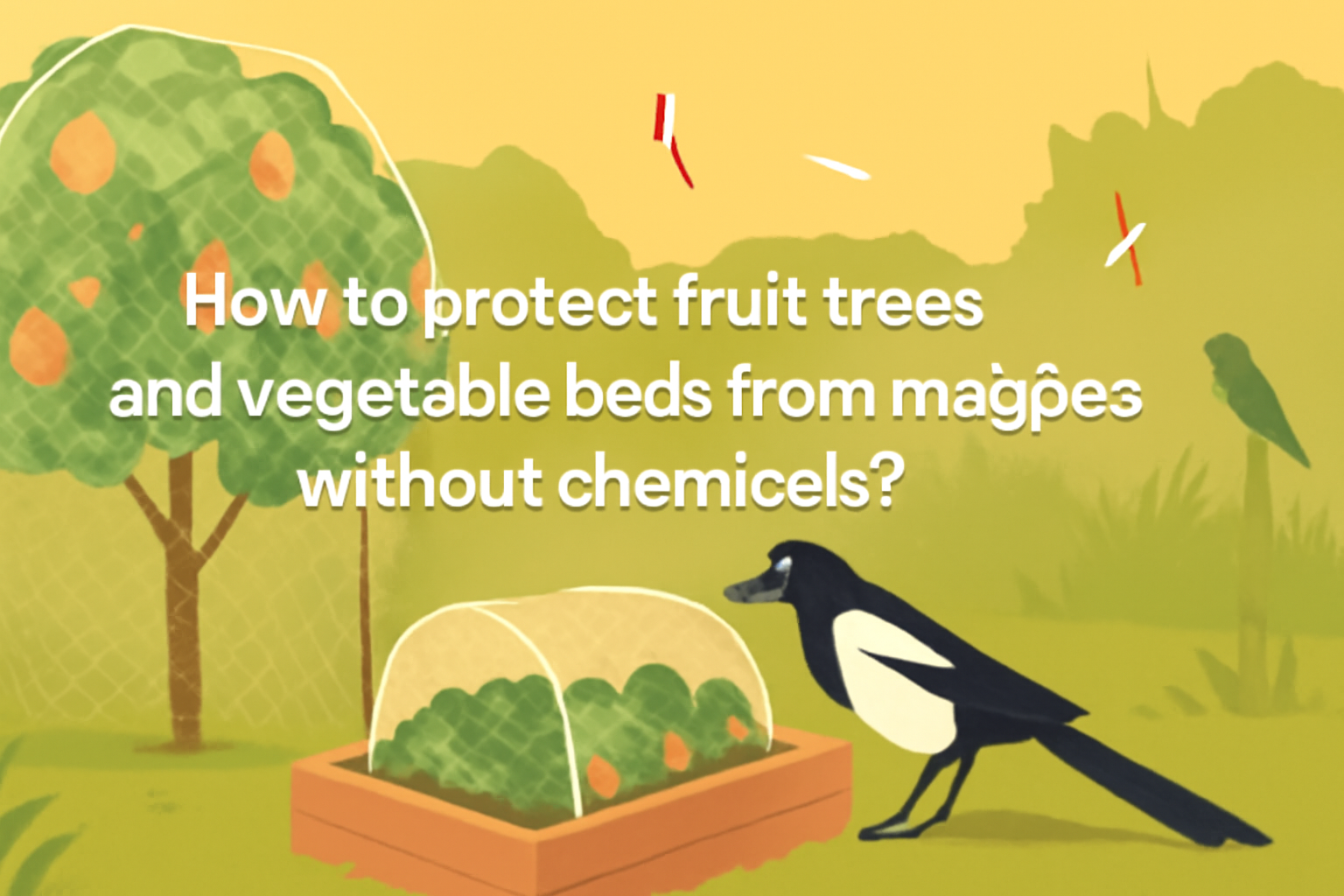
How to Protect Fruit Trees and Vegetable Beds From Magpies Without Chemicals?

“`html
Magpies are incredibly intelligent birds that can systematically destroy your fruit harvest within weeks, leaving you frustrated and your trees bare. But here’s the good news: you can protect your crops without chemicals by understanding how magpies think and implementing the right combination of proven methods. In this guide, I’ll walk you through seven proven non-chemical protection strategies, from physical netting to habitat design, complete with installation details, seasonal timing, and troubleshooting solutions that actually work.
Why Magpies Target Your Fruit Trees and Vegetables: Understanding the Challenge
If you’ve watched magpies systematically strip your fruit trees or demolish your vegetable bed, you know the frustration of garden predation. Unlike insects, magpies are highly intelligent birds that quickly learn to defeat deterrents. Yet protecting your crops without chemicals is absolutely possible if you understand their behavior and choose the right methods.
Over my decade working with gardeners and farmers, I’ve seen how magpie intelligence creates a unique challenge. These birds aren’t random foragers. They remember food sources, communicate successful hunting locations to their families, and adapt rapidly when deterrents fail. This is why single-method approaches often fail within 2-3 weeks. Success requires understanding magpie behavior patterns and rotating your defense strategies before they adapt.
| Photo | Popular Pest Repellents | Price |
|---|---|---|

|
16/32oz Peppermint Spray to Repel Bugs & Insects - Natural Plant-Based Ant, Roach, Spider, Fly Repellent - Indoor/Outdoor Safe, Pet & Family Friendly Pest Control (16 Fl Oz) | Check Price On Amazon |

|
Nature's Dome Pest Control Starter Kit – Makes 3 Bottles (16 oz Each) – Eco-Friendly, Plant-Based Formula for Ant, Roach, Spider, Fly, Flea & Insect Control – Child & Pet Safe for Indoor/Outdoor Use | Check Price On Amazon |

|
(2025 Upgraded) Ultrasonic Insect & Pest Indoor Repeller – Stronger Driving Force, Plug-in Control Electronic Repellent for Roach, Mouse, Rodent, Bugs, Spider, Mice, Ant, 2 Mode Switching (6 Pack) | Check Price On Amazon |

|
LONYEON 8L Electric ULV Cold Fogger Machine with Backpack Mist Atomizer, Adjustable Flow Rate, Large Area Spraying for Home Indoor Outdoor | Check Price On Amazon |

|
Pest Control, Mouse Repellant Pouches, 10 Pack, Mice Repellent Indoor, Peppermint Oil for Rodents & Cucarachas & Spiders & Snakes, Safe Effective Rodent Repellent for Car Engines, RV, Home Use | Check Price On Amazon |
What Makes Magpies Different from Other Garden Birds
While other garden birds feed on insects or leftover seeds, magpies actively hunt fruit and vegetables with calculated precision. More importantly, they are problem-solvers.
Magpies belong to the corvid family, among the most intelligent birds on Earth. They can solve multi-step problems, recognize individual humans, and remember punishment or reward for years. A magpie family group returns to profitable food sources an average of 3-5 times daily during ripening season. Habituation to visual deterrents occurs within 2-3 weeks for individual birds, and learned avoidance can be passed to the next generation in family groups.
This intelligence is why combination methods and rotation are essential. You’re not just installing a barrier; you’re managing an adversary that learns from experience.
How Magpies Find and Target Ripening Fruit
The question most frustrated gardeners ask is simple: “How do magpies find my fruit before it’s even obviously ripe?” The answer involves a combination of visual acuity, learned patterns, and seasonal memory.
Magpies have superior color vision to humans in the red and yellow spectrum. They detect color changes in ripening fruit that aren’t visible to our eyes. As aromatic compounds increase during ripening, magpies respond by adjusting visit frequency to 3-5 times daily during peak ripeness. They begin reconnaissance visits 2-3 weeks before fruit is fully ripe, essentially preparing a feeding schedule.
This is why timing your protection to the ripening window is critical. It must start before magpies even begin their systematic assault.
Seasonal Magpie Patterns and Protection Timeline
Magpie predation isn’t constant throughout the year. Understanding seasonal patterns lets you deploy protection strategically and maintain it exactly when needed.
Spring and early summer involve low to medium magpie activity as birds focus on breeding and insect feeding. Reconnaissance visits increase in late spring. Mid-summer marks escalating pressure as berries ripen and family groups become more active. Late summer through fall represents peak predation, when most fruit crops ripen and magpies make daily systematic attacks. Winter pressure declines as natural food availability returns.
Protection installation should begin 2-3 weeks before expected ripening. Peak protection is needed during the 4-6 week window when primary fruits are ripe. Timing varies by 2-4 weeks depending on region and weather. Some vegetables remain vulnerable longer than fruit crops, requiring extended growing season protection.
The Seven Most Effective Non-Chemical Methods to Protect Your Garden
If you implement one method alone, you will likely see initial success followed by magpie adaptation within 2-4 weeks. The most successful gardens use combination approaches, rotating methods to prevent habituation.
Method Comparison and Effectiveness Overview
| Method | Type | Difficulty | Cost Range | Durability | Best For |
| Physical Netting | Exclusion | Moderate | $150-500 | 2-5 years | All fruit types |
| Visual Deterrents | Deterrent | Easy | $20-100 | 2-4 weeks | Prevention phase |
| Predator Decoys | Deterrent | Easy | $30-150 | 3-6 weeks | Mixed gardens |
| Audio Deterrents | Deterrent | Easy | $40-300 | 2-4 weeks | Large areas |
| Motion Systems | Active Deterrent | Moderate | $100-400 | 4-8 weeks | Large areas |
| Habitat Modification | Environmental | Difficult | $200-1000 | Permanent | Long-term |
| Acceptance and Loss Mitigation | Philosophical | Low | $0 | Ongoing | Ethical gardeners |
No single method is 100% effective long-term. Magpie intelligence means rotation and variation prevent adaptation. Effectiveness timeline varies significantly: fast-acting methods lose effectiveness quickly, while slow methods build over time. Cost ranges widely, meaning budget gardeners have effective options.
Method 1: Physical Netting for Complete Magpie Protection
Physical netting is the most effective method because it removes the decision-making from magpies entirely. They cannot peck through properly installed netting. Many gardeners worry about aesthetic concerns, but remember that netting is a seasonal installation only, lasting from fruit development through harvest.
Types of Bird Netting and Material Selection
Not all netting is created equal for magpie protection. The wrong mesh size, material, or installation technique creates problems including bird entanglement, easy tearing, and ineffectiveness.
The best option is 10mm knotless polyethylene netting, which prevents entanglement and proves magpie-proof. Adequate alternatives include 12mm netting for smaller trees. Avoid loose-weave netting or oversized mesh because magpies can peck through larger gaps.
Quality netting typically lasts 3-5 years before requiring replacement. Check annually for damage and repair as needed. Knotless netting is critical for bird safety. Knots create entanglement points if birds become caught. Properly installed knotless netting significantly reduces this risk.
For a medium fruit tree, you’ll need 8-15 meters of netting. Large fruit trees require 20-35 meters. A vegetable bed measuring 4 meters by 2 meters needs 12-16 meters. Calculate your needs by measuring length plus width, multiplying by 2, adding the height, then adding 1 meter for overhang and overlap.
Step-by-Step Netting Installation Guide
Proper installation is critical. Loose, poorly secured netting creates gaps that magpies will exploit. Follow these steps precisely for guaranteed effectiveness.
Step 1: Prepare the Area (Week Before Installation)
Remove low branches that magpies could perch on to reach under netting. Prune branches to create clearance of at least 30cm gaps around netting perimeter. Install support frames if using netting on low bushes or vegetable beds. Verify there are no entry points at soil level, which is important for excluding both magpies and pest insects.
Step 2: Assess Tree or Plant Dimensions
Measure height, width, and length to calculate netting needed. Standard calculation: multiply length plus width by 2, add height, then add 1 meter for overhang and overlap. Mark installation points where netting will be secured. Identify potential stress points where weight will concentrate.
Step 3: Secure Netting Foundation
Start at one corner, securing netting to ground or support structure. Use fasteners every 30-45cm, spacing them closer for greater security. Tension the netting moderately, allowing slight give rather than drum-tight tension. Work systematically around the entire perimeter. Netting edges should reach ground or base platform with no gaps.
Step 4: Create Sealed Overlap
Where netting joins or overlaps, overlap by a minimum of 10cm. Secure overlap with fasteners every 15cm. Test by trying to pull netting apart; it should resist firmly. Verify no gaps larger than 5mm exist anywhere, as magpies can exploit larger gaps.
Step 5: Inspect and Test
Walk the entire perimeter checking for gaps. Look underneath for entry points. Tug on netting in multiple places; it should not shift or tear. Install bright-colored string at potential weak points. If string is moved, reinforce that location immediately.
Step 6: Monitor During Installation
During the first week, check daily as birds may test frequently initially. Weeks 2-4 represent the settling period; check every three days. After week 4, switch to weekly maintenance mode.
Common Netting Problems and Solutions
Even with careful installation, issues arise. Here’s how to diagnose and fix common netting problems before magpies exploit them.
If magpies peck holes, the cause is usually loose netting vibration. Increase tension and add internal support. If netting sags, you have insufficient support points; add support poles at 1.5 meter intervals. Gaps at soil level indicate settling or improper anchoring; reposition foundation and use ground stakes. When netting tangles with branches, this means branches are too close; prune back and reinstall with 30cm clearance. If fasteners pull loose, replace them with stronger versions every 30cm using marine-grade fasteners. Water pooling on netting means sagging sections; install with minimal slope for drainage. UV degradation and whitening indicate sun exposure; apply UV-protective coating annually or choose UV-resistant netting initially. Bird entanglement signals rough edges or knots; install knotless netting exclusively and smooth all edges.
Seasonal Installation and Removal Timeline
Installation timing is critical. Too early and you create unnecessary barriers; too late and magpies have already caused damage.
Six to eight weeks before peak ripening, plan and gather materials. Four weeks before ripening, install support structures like frames and stakes. Two weeks before ripening, complete netting installation and testing. During peak ripening, perform daily or every-other-day monitoring. One week after ripening ends, harvest remaining fruit and assess damage. Within two weeks of final harvest, remove netting and store properly. During the off-season, clean, inspect for damage, and plan improvements.
Timing varies by region. In the UK, begin July 1-15. In North America, timing depends on elevation; lower elevations (below 4,000 feet) begin mid-July, while higher elevations start later. Australia’s eastern regions begin April 1-15. Always reference your region’s specific ripening calendar for your fruit varieties.
Store netting in a cool, dry location away from direct sunlight. Inspect before next season for damage and repair or replace as needed.
Method 2: Visual Deterrents for Magpie Management
Visual deterrents work initially by triggering predator-avoidance or confusion responses in magpies. They’re excellent for prevention and early-season deterrence. However, magpies habituate quickly, making rotation essential to maintain effectiveness.
How Visual Deterrents Work on Magpies
Visual deterrents work through multiple mechanisms. Unexpected movement or reflections cause initial avoidance. Magpies avoid shapes resembling predator silhouettes with eyes and wings. Shiny surfaces confuse magpies about fruit location. New objects trigger caution until magpies recognize they’re harmless.
The critical point is this: magpies learn. Once they observe that reflective materials or decoys don’t represent actual threats, effectiveness drops dramatically.
Days 1-3 show high effectiveness at 80 percent or more deterrence. Days 4-10 see moderate effectiveness at 50-70 percent deterrence. Days 11-21 show low effectiveness at 20-40 percent deterrence. By day 21 and beyond, minimal effectiveness remains as magpies ignore deterrents entirely.
Visual Deterrent Types and Specific Implementation
Several visual deterrent types exist, each with specific placement and rotation protocols that maximize effectiveness.
Reflective Tape and Materials
Shiny adhesive tape or mylar sheets work through light reflections that distract magpies from fruit detection. Apply strips to tree branches at 30-50cm intervals. Cross-weave to create movement response. Ensure strips reflect sunlight by orienting toward the light source. Focus on perimeter branches where magpies land. Check weekly and re-tension loose strips because wind loosens them. Replace tape every 2-3 weeks or combine with other methods. Cost is $5-20 for medium tree coverage.
Old CDs and Reflective Objects
Suspended shiny discs create movement plus reflections that confuse magpies. Drill a hole in CD center. Suspend on fishing line at varying heights. Space 1 meter apart within tree canopy. Ensure they swing freely in breeze. Place at tree center and around perimeter. Check monthly for tangled lines and re-tension. Supplement with other methods after week 2. Cost is free if using recycled CDs or $10-15 for purchased reflective discs.
Predator Decoys and Silhouettes
Fake hawk, owl, or eagle figures trigger innate fear responses in magpies. Place at high points in or above trees where real predators would hunt. Position to be visible from magpie approach angles. Ensure the decoy doesn’t block fruit access completely; magpies must see the “predator” for threat credibility. Move position every 3-4 days because magpies learn static objects are safe. Change decoy types weekly, alternating hawk and owl. Cost is $15-50 for realistic decoys or $5-15 for basic silhouettes.
Moving and Spinning Objects
Reflective spinners, pinwheels, or hanging ribbons work through constant unpredictable movement that triggers predator-avoidance. Suspend from high branches on fishing line. Position to rotate freely in breeze. Space 1 meter apart around tree perimeter. Position to be visible from primary magpie approach angles. Check weekly for tangles and ensure free rotation. This method works longer than static deterrents, lasting 3-4 weeks, because movement varies naturally. Cost is $3-10 per spinner, typically needing 6-8 for a medium tree.
Visual Deterrent Rotation Strategy for Extended Protection
Rotation is the secret to extended visual deterrent effectiveness. Instead of abandoning them after 2-3 weeks, rotate and combine them strategically.
Weekly Rotation Strategy (Maximum Effectiveness)
Week 1: Deploy reflective tape plus CD spinners (dual visual stimuli). Week 2: Remove tape and add predator decoy (owl). Week 3: Replace with different predator decoy (hawk) plus spinners. Week 4: Reflective tape returns without decoys. Week 5 and beyond: Repeat the cycle.
Layered Multi-Method Strategy (Longer-Term)
Keep basic reflective tape permanently in place. Rotate predator decoys every 3-4 days. Introduce audio deterrents during peak predation period. Result: effective protection for 6-8 plus weeks with proper maintenance.
Daily Maintenance
Conduct visual inspection for movement, placement, and damage. Weekly: check replacement items, worn tape, or broken spinners. Every 3-4 days: change decoy position. Every 2 weeks: refresh reflective material.
Novelty is your ally. Any time a magpie habituates, change the visual stimulus. The element of surprise resets their learning.
Method 3: Predator Decoys and Strategic Placement
Magpies have natural predators, primarily hawks and owls. A realistic predator decoy triggers innate fear responses. However, magpie intelligence means static decoys lose effectiveness quickly. Success requires understanding how to choose between decoy types and maintain effectiveness through movement.
Predator Types: Hawk vs. Owl Decoys
Magpies fear two primary predators, and understanding which presents the more credible threat helps you choose the most effective decoy.
Hawk Decoys
Hawk decoys are highly effective during daylight hours, the primary magpie feeding window. Magpies have evolved specific predator-avoidance responses to raptors during feeding. Hawks hunt visible prey during flight, and magpies interpret hawk silhouettes as active hunting threats. Most effective are decoys resembling red-tailed hawks or sharp-shinned hawks, your regional predators. If kept static, these last 2-3 weeks. With daily position changes, effectiveness extends to 4-6 plus weeks. They represent the primary decoy choice for daytime fruit and vegetable protection.
Owl Decoys
Owl decoys provide moderate daytime effectiveness and work year-round. Owls are known magpie predators, especially at dusk, triggering instinctive caution. This creates general unease rather than active threat perception. Generic owl shapes work, though realistic eyes and head movement increase effectiveness. Static decoys last 3-4 weeks; position rotation extends to 5-8 weeks. They serve as secondary decoys or year-round additions by rotating with hawks. Recommendation: Start with hawk decoys for highest initial effectiveness, rotate to owl after 3-4 weeks, then alternate weekly.
Strategic Placement for Maximum Effectiveness
Placement is critical. A realistic decoy in the wrong location won’t trigger the predator-response magpies expect.
Position Decoys at High Points Where Real Predators Would Hunt
Decoys must appear to be actual hunting threats. For a medium fruit tree, place a single decoy at the apex. For large trees, use central decoy plus secondary at 60-degree angle, ensuring both are visible. All decoys should have clear line-of-sight to fruit area, making the threat credible.
Place the decoy at your tree’s highest point or above vegetable bed perimeter at 1.5-3 meter minimum height. Orient to face toward prevailing wind for movement appearance. Position for visibility from multiple magpie approach angles. This placement makes magpies interpret the position as active predator watching the resource.
Rotate Position Every 2-3 Days
Maintain original location for credibility. Move to secondary location for rotation. Shift minimum 2-3 meters between rotations. Rotate position early morning before magpie feeding window. Randomize movement patterns so magpies can’t predict decoy behavior.
Maintaining Predator Decoy Effectiveness Through Maintenance
Magpies learn quickly that static decoys are harmless. Maintenance extends effectiveness from weeks to months.
Daily Tasks (5 Minutes)
Conduct visual check ensuring decoy is intact and visible. Confirm it hasn’t shifted or become hidden by branches. Clear any branches or vines obscuring the decoy.
Every 2-3 Days (10-15 Minutes)
Move decoy 2-3 meters to new location. Keep a log of movement because magpies track patterns; randomization defeats this. Rotate 90-180 degrees to present new angle.
Weekly (20 Minutes)
Swap hawk for owl decoy. Inspect for damage, UV degradation, or weather wear. Ensure realistic details like eyes and feathers are visible and clean. Clean away dirt, leaves, and spiderwebs because realism affects credibility. Replace faded or damaged decoys.
Every 2-3 Weeks
If using primary-only decoy, compare against backup decoys in storage. Assess whether current location remains optimal as trees grow or positions shift. Consider predator position from all magpie approach angles.
If magpie visits increase despite maintenance, effectiveness is waning. Advance to combination methods by adding audio deterrents or physical barriers.
Method 4: Audio and Noise Deterrents
This method addresses widespread skepticism about audio deterrents. Most commercially available audio deterrents, especially ultrasonic types, are ineffective on magpies. This section explains why, identifies which methods do work, and shows how to use audio as a supporting strategy rather than a primary method.
Audio Deterrent Types and Effectiveness Comparison
Audio deterrents range from ineffective to moderately helpful. Understanding which work prevents wasted time and money.
Ultrasonic Deterrents
Electronic devices emit high-frequency sounds above 20kHz human hearing range. The common claim states they repel birds through discomfort without human disturbance. Effectiveness on magpies is poor to ineffective at 10-20 percent initial deterrence. This fails because magpies hear differently than humans. They have superior hearing at lower frequencies, not ultrasonic. High-frequency sounds don’t discomfort magpies. Birds habituate within 2-3 days. Recommendation: Skip these; they represent wasted money.
Audible Alarm and Siren Sounds
Electronic devices play bird distress calls, predator sounds, or loud alarms. Effectiveness is moderate at 40-60 percent initial deterrence. This works because magpie distress calls trigger instinctive avoidance. Predator sounds create threat perception. Novelty causes initial caution. However, habituation occurs in 1-2 weeks as magpies realize no actual danger exists. Noise pollution affects neighbors and garden environment. Inconsistent timing is an issue because devices run on preset schedules, not magpie-triggered responses. Best use: short-term (2-3 weeks) in early prevention phase. Cost is $40-150. Recommendation: Useful as rotating component, not primary method.
Motion-Activated Audio Systems
Devices emit sound only when movement is detected. This represents a more intelligent approach than constant noise. Effectiveness is good at 60-80 percent initial deterrence. This works because magpie-triggered response pairs sound with motion, creating credible threat appearance. Unpredictable timing creates stronger startle response. Limitations include magpie habituation in 2-4 weeks and rapid movement through detection zones. Requires power source (battery or electrical). Best use: supporting method in combination approaches; mid-season addition after visual deterrents fade. Cost is $80-200. Recommendation: Effective as rotating component in 4-6 week rotation cycle.
Simple Noise Makers
Non-electronic tools include bells on branches, wind chimes in trees, aluminum pie tins, whistles, or recorded hawk cries. Effectiveness is poor to moderate at 30-50 percent initial, dropping quickly. This works through novelty and unpredictability creating initial caution. Predator call recordings prove more effective than pure noise. Limitations include very rapid habituation in 1-2 weeks and minimal startle effect compared to other methods. Requires wind or activity for noise, making it unreliable. Best use: budget-friendly option; combination with other methods. Cost is very affordable at $3-20. Recommendation: Worth trying given low cost, but plan to upgrade quickly.
When to Use Audio Deterrents in Your Strategy
Audio deterrents shouldn’t be your primary method, but they serve specific roles in combination strategies.
Use Audio Deterrents During These Periods
Deploy during weeks 3-4 of protection cycle when visual deterrents are losing effectiveness. Use during prevention phase before magpies establish routine; noise discourages initial assessment visits. Deploy spring season when fresh noise deters reconnaissance visits. Use in supporting role by combining with physical barriers or predator decoys.
Avoid Audio Deterrents If
Physical netting is already protecting fruit, making audio unnecessary and adding noise pollution. You’re in sensitive environment with nearby neighbors or early-morning concerns. Budget is limited; spend on physical barriers instead. Goal is humane/minimal environmental impact because audio creates ecosystem disturbance.
Strategic Integration Timeline
Week 1-2: Deploy visual deterrents (highest initial effectiveness). Week 3-4: Add motion-activated audio system as visual effectiveness declines. Week 5 and beyond: Upgrade to physical netting or rotate back to fresh visual deterrents. For ongoing prevention: Save audio for preventing new magpie family groups from establishing residence.
Method 5: Motion-Activated Systems for Extended Protection
Motion-activated systems represent the next tier of sophistication. These tools respond to magpie presence specifically, creating dynamic deterrents that resist habituation better than static methods.
Motion-Activated Sprinkler Systems
Motion-activated sprinklers deter magpies through multiple mechanisms: sudden water spray, unpredictable timing, and physical discomfort. Unlike static deterrents, each magpie encounter is distinct, reducing habituation.
How They Work
Passive infrared sensors detect movement when magpies land or approach. A timer delay of 0.5-1 second triggers water spray. Magpies receive unexpected water bursts, which are uncomfortable but harmless. Brief 2-3 second sprays minimize water waste. Magpies learn the area is unpredictable and avoid landing.
Installation Protocol
Position the sensor at tree canopy height, aimed at expected magpie landing zones. Height should be 0.5-1.5 meters for effective magpie detection. Install one system per 3-4 meters of tree canopy. Set water pressure to medium for sufficient spray distance without drowning. Connect to timer operating during peak magpie hours or use motion-only mode.
Effectiveness Data
Initial effectiveness is 70-80 percent deterrence. Week 2-4 shows 60-70 percent effectiveness as some habituation occurs, but slower than visual deterrents. Week 5-8 shows 50-60 percent effectiveness as magpies learn behavior. Month 3 and beyond drops to 40-50 percent. Best used seasonally rather than year-round. Initial investment is $100-300 per system. Water usage is 2-5 gallons per deterrent event depending on trigger frequency. Optimal effectiveness window is 4-8 weeks.
Cost-Benefit Analysis
Consider whether your fruit value justifies initial investment. Effectiveness is better on large gardens where ROI improves. The system can serve dual purposes, providing both watering and deterrence, reducing effective cost. Can be used across multiple seasons, improving long-term value.
Moving Decoy Systems
Moving decoy systems, whether motorized or wind-driven, extend visual deterrent effectiveness by introducing constant unpredictable movement that mimics active predator behavior.
Battery-Powered Motorized Decoys
Motors create wing flapping or body rotation with continuous or intermittent movement patterns. Effectiveness is 60-75 percent, with movement overcoming static habituation faster. Effectiveness lasts 4-8 weeks before batteries deplete or magpies fully habituate. Cost is $30-80 per unit. Mount at high point and operate during peak magpie hours.
Wind-Driven Spinning Decoys
Wind causes rotation and spinning movement with variable patterns dependent on wind conditions. Effectiveness is 50-70 percent as unpredictability prevents timing prediction. Lifespan is 6-10 weeks as movement variability slows habituation. Cost is $15-40 per unit. Mount on post or tree in wind-exposed location.
Strategic Deployment
Deploy moving decoy systems after static decoys show decline around week 3-4, maintaining momentum in visual deterrent effectiveness without complete restart.
Method 6: Habitat Modification for Long-Term Magpie Management
This method shifts perspective fundamentally. Instead of asking “How do I stop magpies?” ask “How do I design an environment where magpies choose elsewhere?” It requires more planning but creates permanent benefits. While deterrents are tactical temporary solutions, habitat modification is strategic permanent ecosystem design.
Understanding Magpie Habitat Preferences and Vulnerability Factors
Magpies don’t appear randomly in gardens. Specific environmental factors make gardens attractive and vulnerable. Reducing these factors makes magpies choose other areas.
Attraction Factors Magpies Seek
They want food availability through ripening fruit exposed and easily accessible. They seek shelter in dense trees or shrubs for escape routes and nesting. They need water sources nearby for drinking and bathing. They appreciate viewing platforms for reconnaissance and meal planning. They avoid areas with perceived predation risk or frequent human activity.
Vulnerability Factors Magpies Avoid
Magpies avoid active raptors or predatory animals using space. They avoid frequent human movement, noise, and unpredictable interactions. Difficult fruit access requiring effort deters them. Limited escape routes without protective cover make them uncomfortable. Hunting pressure or previous negative experiences trigger learned avoidance.
Optimal habitat modification removes attraction factors and increases vulnerability factors simultaneously. This isn’t about making gardens less attractive overall; it’s about making them specifically less attractive to magpies.
Specific Habitat Modifications and Garden Design Changes
Here are specific, implementable changes that reduce magpie predation pressure through environmental redesign.
Reduce Dense Shelter Near Fruit Trees
Dense shrubs provide escape cover, making magpies feel secure. Remove or thin shrubs immediately adjacent to fruit trees, within 2-3 meters. Magpies must land directly on trees without safe feeling. Predator escape becomes longer and more dangerous. Implementation: Gradual removal over season to avoid sudden gaps. Complementary action: Install open-branched understory with shrubs 1-2 meters tall but sparse foliage. Timeline: 1-2 seasons for full effect.
Strategic Water Feature Placement
Water sources attract magpies and establish territory confidence. Remove or relocate standing water like bird baths and shallow ponds away from fruit gardens. Magpies choose areas with water access, so distance reduces fruit area visits. If removal is impossible, relocate 30 meters from fruit zones. Implementation: One-time action for immediate effect. Alternative: Install hidden water source not visible from fruit area to redirect magpie visits. Timeline: Immediate.
Increase Open Sightlines and Reduce Safe Landing Zones
Magpies need clear views for predator detection. They avoid exposed positions. Remove low-hanging branches creating protected landing routes. Thin canopy selectively to remove fruit access routes. Fruit becomes harder to reach safely, increasing risk in magpie threat assessment. Implementation: Selective pruning of branches within 2 meters of fruit; keep higher structure intact. Complementary action: Plant thorny shrubs like hawthorn, holly, or berberis below fruit trees, creating physical barriers and bird deterrents. Timeline: 1-2 growing seasons.
Introduce Predator Habitat
Active raptor or predator presence creates genuine threat perception. Create habitat favoring raptors by installing tall poles or dead trees as perches. Maintain open sight lines for hunting. Plant native vegetation supporting prey species. Magpies learn through observation that the area is dangerous; they avoid feeding. Implementation: Install tall poles or dead trees for hawk perches. Maintain open ground for hunting (lawn areas). Plant native vegetation supporting small mammals and insects. Complementary action: Tolerate natural predation; don’t intervene in hawk or magpie encounters because learning reinforces threat. Timeline: 6-12 months for predator attraction; 1-2 years for magpie behavioral change.
Strategic Fruit Tree Positioning and Orientation
Tree location and exposure affect magpie assessment of safety. Position with open access to nearby clear areas (paradoxically, making environment less comfortable for magpies). Magpies must commit to feeding in open, discomfort with visibility increases flight time (energetically costly). Implementation: During new planting, position with 4-5 meter clearance on primary approach angle. For existing trees, remove obscuring vegetation to increase magpie discomfort. Timeline: Planning action for new planting; gradual implementation for existing trees.
Integrating Habitat Modification with Active Deterrence
Habitat modification works best combined with active deterrence during transition period. This layered approach provides maximum effectiveness and permanent protection.
Implementation Timeline
Year 1: Implement active deterrence (netting, decoys) while beginning habitat modifications. Focus on shelter reduction, water relocation, and open sightline creation. Year 2: Maintain active deterrence; observe magpie response to environmental changes. Continue modifications. Year 2-3: Predator habitat matures; magpie pressure typically decreases 40-60 percent. Gradually reduce active deterrence as habitat modifications show effect. Year 3 and beyond: Habitat modifications maintain protection permanently with minimal active deterrence.
Full habitat-based protection typically requires 2-3 years. This is the longest implementation timeline, but results in permanent, low-maintenance protection.
Method 7: Acceptance and Loss Mitigation Strategy
This final method represents a philosophical shift rather than tactical intervention. For some gardeners, particularly those prioritizing ethics and ecosystem health, accepting some magpie predation while implementing smart mitigation strategies is the optimal solution. This isn’t failure; it’s intentional design choice based on values.
The Coexistence Framework for Ethical Gardeners
The coexistence approach inverts the problem statement. Instead of “How do I eliminate magpie predation?” ask “How much predation is acceptable, and what can I do to support it sustainably?”
Core Coexistence Principles
Magpies are natural predators; their presence indicates healthy ecosystem. If you value wildlife, accept that wildlife includes predation on crops. Design gardens expecting some loss; plan crop volumes accordingly. Optimize yield despite predation rather than eliminating predation. This approach eliminates moral burden of harming or excluding magpies. It reduces maintenance burden since no deterrent upkeep is required. It supports broader ecosystem health through predator presence that controls rodent populations. Long-term garden health improves through diverse predator/prey relationships. This aligns with regenerative agriculture principles. Resource and chemical use reduces.
Honest Assessment
This approach requires mindset shift and acceptance of 15-30 percent crop loss in some scenarios. It’s not for everyone, but it’s valid and increasingly aligned with ecological values.
Strategic Loss Mitigation Tactics
Even within acceptance framework, smart strategies minimize loss without harming magpies.
Sacrifice Crop Zones
Plant extra fruit or vegetables specifically designated for magpie consumption. Acceptance framework means planting 20-30 percent additional crop volume; understand that portion will be lost. Magpies become satisfied with designated area; remaining crops see reduced pressure. Examples: Extra berry bushes for magpies (they consume first; remaining berries go to humans). Perimeter vegetable bed designated for birds; inner beds receive light protection. Specific fruit tree left unprotected; other trees receive protection.
Temporal Separation
Time protection to specific vulnerability windows rather than year-round. Protect only during peak ripening (4-6 weeks); remove protection outside peak windows. This reduces maintenance burden significantly; protects maximum-value harvest window; allows magpie access to lower-value fruit. Result: 40-50 percent of crop protected (most valuable period); remainder available for magpies.
Strategic Crop Density
Plant sufficient volume so post-predation loss meets household needs. Calculate typical predation rate; plant to compensate. Example: If expecting 25 percent loss, plant 33 percent more volume. Benefit: Sustainable yield despite predation; no harm to magpies; guaranteed success. Resource cost involves increased planting space and effort, not increased protection methods.
Crop Diversification
Grow wide variety of crops so predation on one or two varieties is acceptable. Multiple fruit species, multiple vegetable types. Magpies prefer some crops over others; these preferences can be managed through location and light protection. May lose 50 percent of one crop type while protecting others; overall yield remains acceptable.
Calculating Acceptable Loss and Financial Framework
Before choosing acceptance approach, do the math. Is crop value worth protection methods? Sometimes acceptance is financially optimal.
Calculation Framework
Step 1: Estimate entire crop value. If purchased, what would you pay? Example: 20kg of apples at $2 per kilogram equals $40 total value. Step 2: Estimate typical loss. Magpie predation rates typically run 15-30 percent for unprotected fruit. Calculate loss value: $40 times 25 percent equals $10 loss. Step 3: Calculate protection costs. Bird netting at $150-300 (5-year durability) equals $30-60 per year. Deterrent system costs $50-200 annually. Labor and maintenance run $20-50 per season. Total annual cost is $100-210. Step 4: Decision matrix. If annual crop value is less than annual protection cost, acceptance makes financial sense. If crop value exceeds protection cost, investment in deterrence is justified. Example: $40 crop value against $150 annual protection cost means acceptance is smarter choice financially and ethically.
If your crop value is under $100 per year, coexistence is both financially and ecologically optimal. Protect valuable crops; accept loss on lower-value crops.
Troubleshooting Failed Approaches and Decision Tree
This section addresses the frustrated gardener whose initial approach failed. Magpie intelligence means adaptation and escalation are expected. Before changing your approach entirely, identify why failure occurred because different causes require different solutions.
Diagnostic Questions to Identify Failure Cause
Question 1: Was There Initial Success?
If yes, then effectiveness declined: Problem is habituation; magpies learned the deterrent is harmless. Solution: Add visual rotation. Next step: Refer to Section 4 on visual deterrent rotation. If no, never worked: Problem is installation quality, placement, or method choice. Solution: Troubleshoot installation or choose different method. Next step: Proceed to Question 3.
Question 2: If Initial Success Occurred, When Did It Stop Working?
Within 1-2 weeks: Magpies learned very quickly (typically predator decoys). Solution: Increase movement and rotation frequency; add complementary method. Next step: Install motion-activated system or add audio deterrent. 2-4 weeks: Normal habituation timeline. Solution: Rotate to different method as planned. Next step: Transition to next method in rotation. 4 plus weeks: Extended effectiveness (rare but possible). Solution: Maintain current approach, rotate preventively. Next step: Continue current method.
Question 3: Physical Installation Issues?
Netting has gaps: Magpies found access points. Solution: Refer to Section 3c troubleshooting guide. Action: Identify gaps, reinforce, test. Deterrents aren’t visible: Placement is wrong. Solution: Reposition per placement guidelines in Section 5b. Action: Move to higher, more visible location. Installation won’t stay secure: Materials or anchoring inadequate. Solution: Upgrade materials and increase anchor points. Action: Use stronger fasteners with closer spacing.
Escalation Strategy and Next Steps
Once you’ve identified why failure occurred, here’s the progression for escalating effectiveness.
Level 1 Failed (Single Deterrent Approach)
Move to Level 2: Add complementary method (example: failed on visual deterrent alone; add audio or predator decoy). Move to Level 3: Implement combination approach (netting as backbone; deterrents as supporting layer). Move to Level 4: Upgrade to active systems (motion-activated sprinklers, motorized decoys). Move to Level 5: Habitat modification (environmental approach for long-term solution). Move to Level 6: Acceptance framework (if all else fails; reevaluate goals).
Critical Decision Point
If you’ve reached Level 4 and effectiveness remains inadequate, it’s time to question whether your goal of 100 percent protection is realistic. Level 5-6 may be more sustainable for your situation.
Regional Variations and Seasonal Timing by Location
This section moves general guidance into specific implementation for your location. Month-by-month action calendars, ripening dates for fruit varieties, magpie species information, and legal requirements vary significantly by region.
UK and European Magpie Protection Timeline
European magpies (Pica pica) peak sharply in late summer. Here’s the month-by-month timeline for effective protection planning.
March-April: Planning Phase
Magpie activity is low as birds focus on breeding and insect feeding. Protective action: Plan garden layout, assess tree sizes, order materials. Fruit status: Spring blossoms appearing; no ripening risk. Key tasks: Inspect protective equipment from previous year; repair or replace damaged items.
May: Preparation Phase
Magpie activity is low to medium as family groups establish territory and breeding continues. Protective action: Install support structures for netting; plant new trees if needed. Fruit status: Early stone fruit setting; peas and early beans ripening. Key tasks: Complete frame installation; verify mounting systems; install protective covers on vulnerable vegetables.
June: Early Installation Phase
Magpie activity is medium as fledglings mature and families learn foraging together. Protective action: Install deterrent systems on early ripening crops. Fruit status: Berries ripening; early apples sizing; stone fruits developing color. Key tasks: Deploy visual deterrents around berry bushes and early fruit; begin daily monitoring.
July: Peak Installation Phase
Magpie activity is high as fledglings mature and reconnaissance visits increase 2-3 times. Protective action: Complete netting installation on all fruit trees; activate full deterrent system. Fruit status: Most berry crops ripening; early stone fruits becoming vulnerable; apples approaching ripeness. Key tasks: Install protective netting on 100 percent of at-risk fruit; verify all deterrents functioning; daily inspection begins.
August-September: Peak Protection Phase
Magpie activity is very high with peak predation and systematic attacks; 3-5 daily visits per family group. Protective action: Intensive monitoring; maintenance; rotation of deterrents; harvesting ripened fruit immediately. Fruit status: Primary ripening period for most fruits; vegetables in peak production. Key tasks: Daily monitoring (morning preferred); immediate harvest of ripe fruit; weekly maintenance; deterrent rotation every 3-4 days.
October: Declining Phase
Magpie activity is medium-high as peak ripening ends and natural food availability returns. Protective action: Continue protection for late-ripening crops; begin removal of netting from completed harvests. Fruit status: Late apples and pears ripening; most other crops finished. Key tasks: Selective netting removal from completed areas; maintain protection on late-ripening crops; assess season effectiveness.
November-February: Off-Season and Storage
Magpie activity is low as winter feeding shifts to insects, seeds, and cached food. Protective action: Remove all netting; clean and store protective equipment. Fruit status: Dormant; minimal fruit available. Key tasks: Complete protective system removal; cleaning and inspection; repair of damaged items; storage in dry location.
Specific UK Dates (Typical)
Earliest soft fruit ripening: June 1-15 (strawberries, gooseberries). Peak berry season: July 15 to August 31 (raspberries, blackcurrants). Apple ripening begins: August 15. Apple peak ripening: September 1-30. Pear ripening: September 15 to October 15. Final harvests: October 31.
Legal Status in UK
Magpies are protected wildlife under Schedule 2 of the Wildlife and Countryside Act 1981. Legal methods include non-lethal deterrence, exclusion, and habitat modification only. Illegal methods include trapping, removal, or killing without specific licenses. Recommendation: Refer to RHS guidance for current regulations; check local authority rules.
North American Magpie Protection Timeline
Magpie distribution in North America is limited to western regions. Timing varies significantly by latitude and altitude. Use the appropriate timeline for your location.
Western North America (Black-billed Magpie, Gymnorhinus cyanocephalus)
Covering: Pacific Northwest (WA, OR), Northern California, Rocky Mountains (MT, ID, WY, CO), Northern Plains (ND, SD, NE).
April-May: Spring Reconnaissance
Magpie activity is medium as spring migration completes and pairs establish nesting territory. Fruit status: Dormant; early spring crops like asparagus and peas emerging. Protection: Light planning; assess tree condition post-winter.
June: Installation Planning
Magpie activity is medium as nesting is active and birds hunt for nesting materials and insect food. Fruit status: Spring vegetables producing; early berries sizing; cherry trees developing fruit. Protection: Install deterrent systems on early ripening crops.
July-August: Peak Protection Phase
Magpie activity is high as fledglings fledge and family groups learn foraging; systematic predation begins. Fruit status: Berries ripening (July); stone fruits peak ripening (late July to August); early apples maturing. Protection: Install netting on all vulnerable fruit; activate full deterrent rotation; daily monitoring.
Timing variation is significant based on elevation. Lower elevations (below 4,000 feet) begin mid-July. Mid-elevations (4,000-7,000 feet) begin late July. High elevations (above 7,000 feet) begin August with short windows.
September-October: Extended Harvest Phase
Magpie activity is medium-high as predation continues through fall; family groups establish winter range. Fruit status: Main apple ripening (September); pears (late September); grapes (early October). Protection: Maintain netting on late-ripening crops; selective removal from finished areas; harvesting priority.
November-March: Off-Season
Magpie activity is low as winter feeding shifts to carrion, stored food, and insects. Fruit status: Dormant. Protection: Removal of protective systems; storage and maintenance.
Regional Variations
Elevation impacts timing significantly: Add 2-4 weeks for every 2,000 feet increase in elevation. Ocean influence (Pacific Northwest) brings earlier ripening and extends season end. Desert Southwest (CA, NV, AZ) experiences earlier season starting 1-2 weeks earlier. Northern Plains (MT, ND) have latest season starting 2-3 weeks later. Always adjust dates based on your specific elevation and microclimate.
Legal Status in US (Varies by State)
Black-billed magpies are legally unprotected in most Western states and classified as hunted species. Removal is legally permissible in many areas; check state wildlife regulations. All non-chemical methods are legal; lethal removal is possible where legal. Recommendation: Verify current state regulations; non-lethal methods are still recommended for humane and pest-prevention reasons.
Australian Magpie Protection Timeline
Australian magpies (Cracticus species) differ significantly from European magpies in behavior and attack patterns. Their aggressive dive-bombing during breeding season is legendary, requiring different protection strategy.
Eastern Australian Regions (East Coast: NSW, VIC, QLD)
December-January: Spring Preparation
Magpie activity is low to medium as birds emerge from post-breeding phase, focusing on insects and available food. Fruit status: Summer crops beginning to fruit, citrus sizing, stone fruits developing. Protection: Light planning; assess previous season damage; order materials.
February-March: Early Protective Installation
Magpie activity is medium as breeding season begins and territory establishment and aggression increase. Fruit status: Stone fruits ripening (February-March peak for peaches, nectarines); citrus developing. Protection: Install deterrents on early ripening crops; protective clothing for outdoor work (magpies dive-bomb during nest defense).
April-May: Peak Protection Phase
Magpie activity is very high during breeding season peak with aggressive territorial defense and systematic fruit attacks. Fruit status: Peak ripening for most stone fruits; apples beginning to ripen; citrus peak season begins. Protection: Complete netting installation; daily monitoring mandatory; protective gear essential for outdoor work.
Special Consideration: Aggressive Breeding Behavior
Australian magpies are notoriously aggressive during breeding season (August-October officially, but food-seeking peaks April-May). Humans should wear protective headgear with eyes or spikes when working outdoors during this period. Magpie protection must include human safety considerations. Deterrent methods should use more aggressive systems; magpies are less responsive to mild deterrence. Some Australian councils coordinate community responses to aggressive magpie populations.
June-August: Extended Harvest Phase
Magpie activity is medium-high as breeding season concludes and juvenile independence increases; predation pressure continues but focus shifts. Fruit status: Apples peak (June-July); pears (July-August); citrus extending into August. Protection: Maintain netting; harvesting priority; protection maintenance secondary.
September-November: Spring Decline
Magpie activity is low to medium as winter feeding completes and natural food abundance increases; predation pressure declines. Fruit status: Final citrus harvest (November). Protection: Selective netting removal; completion of harvest; storage and maintenance.
Legal Status in Australia (Varies by State)
Australian magpies are native protected species nationwide. Lethal removal is only possible under specific permits requiring demonstration of danger or significant agricultural impact. Non-lethal methods are strongly encouraged; lethal removal is increasingly restricted. Recommendation: Focus on non-lethal methods; contact local wildlife authority for advice on aggressive populations.
Safety and Ethical Considerations in Magpie Protection
This section addresses two critical concerns: preventing unintended harm to magpies and other birds during implementation, and ethical decision-making around whether protection methods align with your values. Non-chemical protection methods are inherently humane, but implementation details matter.
Preventing Bird Entanglement and Safety Hazards
Properly installed protective systems are safe for birds, but poor installation creates entanglement risks. Here’s how to prevent and respond to emergencies.
Prevention Protocols During Netting Installation
Use knotless netting exclusively because knots create entanglement points. Smooth all edges, using edge binding if necessary. Eliminate access gaps so birds shouldn’t fit through holes. Secure loosely enough to allow bird exit if they do get in (not drum-tight tension). Avoid netting around full tree; create escape route at one point.
During Deterrent Installation
Avoid string and wire entanglement hazards by using secure fastening, not loose loops. Ensure decoys don’t have sharp edges or protruding fasteners. Check motion-activated systems for pinch points. Verify audio deterrents aren’t so loud they disorient birds, which may cause crashes.
During Maintenance
Weekly inspection should check for accumulated debris because netting can trap fallen branches. Check for accumulated leaves and vines that create hidden gaps. Verify no netting deterioration creating sharp edges.
Emergency: Bird Entanglement
Stay calm because stressed magpies may injure themselves further. Approach slowly with gentle, non-threatening movement. Wear protective gloves because magpies can bite and scratch. Work slowly to free wings and legs. Release appropriately by allowing birds to recover in quiet space before releasing. Document the incident and assess what allowed entanglement to prevent recurrence. Most entanglement indicates installation error, not method failure.
Ethical Framework and Value Alignment
Different gardeners have different values regarding wildlife. This section helps you evaluate whether your protection method aligns with your ethics.
Ethical Questions to Ask Yourself
Do you value coexistence with wildlife, or do you prioritize crop protection? If using netting, are you comfortable with exclusion (displacement) rather than harm? What percentage of crop loss is acceptable given your values? Do you prioritize ecosystem health or crop yield? Is the effort and cost of protection justified by crop value? Is the method truly non-chemical and humane?
Decision Framework
If values prioritize crop protection: Netting plus deterrents are fully justified. If values prioritize coexistence: Acceptance framework plus habitat modification align best. If values are mixed: Combination approach balancing both concerns works well.
There’s no “right” answer; only your answer matters. Choose methods that align with your values, not guilt or external pressure.
Frequently Asked Questions About Magpie Protection
Is bird netting really the most effective method, or will magpies just break through?
Properly installed bird netting is 95 percent plus effective because it provides complete physical exclusion. Magpies cannot peck or tear through correctly installed 10mm knotless polyethylene netting. The key is proper installation: adequate tension, secure fastening, and no gaps larger than 5mm. Loose or damaged netting is vulnerable, but that’s an installation problem, not a netting problem.
How long do deterrents really work before magpies stop responding?
Initial effectiveness ranges from 2-4 weeks depending on method type. Visual deterrents typically peak at days 1-3, then decline to 20-40 percent effectiveness by day 21. Motion-activated systems last 4-8 weeks. Predator decoys with daily rotation last 4-6 weeks. The key is rotation: change methods before complete habituation prevents magpies from fully learning that deterrents are harmless.
Can I protect my garden using only chemical-free methods without netting?
Chemical-free protection is absolutely possible without netting, though effectiveness and effort vary. Single-method approaches provide 40-70 percent protection with 2-4 week effectiveness windows. Netting provides 95 percent plus protection with seasonal maintenance. For small crops or prevention-phase gardens, deterrents alone can work. For established magpie predation or high-value crops, netting combined with deterrents is most reliable.
What’s the difference between magpie predation and damage from other birds?
Magpies create distinctive damage patterns. They typically remove entire fruits or large chunks, creating precise beak wounds at fruit stems, and attack systematically with 3-5 organized visits daily rather than opportunistic feeding. Other birds peck at individual berries without removing them completely. Magpie damage is larger-scale, more organized, and involves missing fruits rather than pecked-at-but-remaining fruit.
If I use netting, will I harm magpies by trapping them inside?
Properly installed netting with gaps eliminated allows bird exit and prevents entrapment. Magpies that accidentally land in netted area can navigate out quickly. Risk is minimal with correct installation using knotless netting and smooth edges. Loose, degraded, or poorly installed netting creates entanglement risk, but that’s an installation failure, not an inherent netting problem.
Do reflective CDs and mirrors actually work, or is this a myth?
Reflective materials provide moderate initial effectiveness at 50-70 percent in days 1-3 through distraction and startle response. Habituation occurs within 7-10 days. They’re cheap and safe, worth trying in prevention phase, but insufficient as standalone methods during active predation. Best use is as rotating component in multi-method approach, not primary strategy.
What’s the best time to install protective netting for maximum effectiveness?
Install netting 2 weeks before anticipated ripening rather than after damage appears. Timing varies by region and fruit type. Northern UK should install July 1-15 (early installations prevent reconnaissance visits). Australia’s eastern regions should install April 1-15 (before stone fruit peak). North America (elevation-dependent) should install mid-July to August 15 (regional variation by elevation). Installing early creates deterrent effect through visible barriers before magpies systematically target fruit. Seasonal checklists help prevent magpie problems during nesting season, so plan accordingly.
Are motion-activated sprinklers effective on magpies, or do they just waste water?
Motion-activated sprinklers provide 70-80 percent initial effectiveness with 4-8 week sustained effectiveness, showing better habituation resistance than visual deterrents. Water usage is 2-5 gallons per triggered event, minimal waste if triggered 5-10 times daily. Cost is $100-300 per system, justified for large fruit areas where ROI exceeds protection cost. Not cost-effective for small crops, but excellent for established orchards.
Can I use ultrasonic deterrents on magpies?
Ultrasonic deterrents are ineffective on magpies (and most birds) because birds hear differently than humans. They’re insensitive to ultrasonic frequencies. Additionally, magpies habituate within 2-3 days to any continuous noise. Skip ultrasonic systems; invest in motion-activated audio or other methods instead.
When exactly should I start protecting my fruit trees in my region?
Timing varies significantly. UK starts July 1-15. North American West (elevation-dependent) starts July 15 to August 15. Australia starts April 1-15. General rule: install 2 weeks before your region’s documented peak ripening date for your fruit variety. Consider which plants or landscaping changes discourage magpies when planning your regional protection strategy.
Do Australian magpies behave differently than European magpies? Should I use different protection methods?
Yes, significant behavioral differences exist. Australian magpies are more aggressive, more territorial during breeding season, and more adaptable learners. Use more aggressive deterrents with strong audio, frequent movement changes, and motorized systems. Netting remains equally effective. Expect to rotate methods more frequently due to faster habituation. Humans must wear protective headgear during breeding season (April-May peak).
Can I protect my vegetables using the same methods as fruit trees, or do I need different approaches?
Vegetable protection is generally easier due to lower height and smaller area. Netting smaller beds requires less material; deterrents reach vegetables more effectively; vegetables often have shorter vulnerable windows (weeks rather than months). Use same methods but scaled down: row covers instead of tree netting, concentrated deterrent deployment. Timing varies: vegetables are vulnerable earlier in season (spring) than fruit trees (late summer). Natural ways to keep magpies off balconies and window ledges apply similarly to raised vegetable beds and containers.
Is accepting some magpie predation a cop-out, or is it a legitimate gardening strategy?
It’s completely legitimate if your values support it and your crop economics allow it. If annual crop value is less than annual protection costs, acceptance is economically rational and aligned with ecosystem values. It’s only problematic if you’ve convinced yourself it’s acceptable while actually being frustrated with loss. Honest assessment of your goals matters more than external judgment.
Will habitat modification actually reduce magpie visits, or is it just theoretical?
Habitat modification works, but slowly. Changes to shelter, sightlines, water sources, and predator presence reduce magpie visitation pressure by 30-50 percent over 1-2 years as magpies learn the area is less favorable. It’s not magic; it’s ecological adjustment. Best combined with active deterrence during transition period, not as standalone immediate solution.
What should I do if I feel guilty about excluding magpies from my fruit?
Reassess your values and goals. If you’re using non-lethal exclusion methods and magpies still thrive elsewhere, you’re not causing harm; you’re protecting your property. If guilt persists, implement acceptance framework (sacrifice crop zones, loss mitigation) instead. Choose the approach that aligns with your authentic values rather than external judgments.
My deterrents worked initially but stopped after 2 weeks. What went wrong?
This is normal habituation. Magpies learned deterrents are harmless. This is expected, not failure. Solution: Rotate to different method per planned rotation schedule as outlined in Method 2. Always plan for 2-3 week deterrent windows; expect to change methods before complete failure.
I installed netting correctly, but magpies still got inside the tree. How is that possible?
Possible causes include gap in netting not noticed during installation (check thoroughly around base and overlap points), netting deteriorated since installation (check for holes, tears, rough edges), netting shifted from wind or settling (re-tension and resecure), or magpies finding and exploiting existing imperfection through repeated testing. Solution: Inspect thoroughly; repair gaps; increase tension; monitor daily for first week.
What do I do if I find a magpie trapped in my netting?
Immediate action: Stay calm to avoid startling the bird. Approach slowly with protective gloves. Gently work netting away from wings and legs. Free the bird and allow it quiet recovery space before it flies away. Follow-up: Inspect netting immediately to identify how entanglement occurred and prevent recurrence. Most entanglement indicates installation error like loose knots, rough edges, or poor fastening.
Key Takeaways: Your Path to Magpie-Free Fruit and Vegetables
Protecting fruit trees and vegetables from magpies without chemicals is entirely achievable when you combine the right methods with proper timing and maintenance. My experience working with gardeners across different regions shows that success depends less on finding the perfect single solution and more on understanding magpie behavior and rotating your defenses strategically.
Physical netting offers the most reliable protection for high-value crops, providing 95 percent-plus effectiveness with seasonal installation and maintenance. Visual deterrents work best during early protection phases but require weekly rotation to prevent magpie habituation. Predator decoys trigger innate fear responses but must be moved every 2-3 days to maintain effectiveness.
The most successful gardens use combination approaches, layering methods strategically. Begin with visual deterrents in spring (low pressure phase). Add motion-activated systems in mid-season as initial deterrents lose effectiveness. Install netting 2 weeks before peak ripening. Rotate all methods before magpies fully habituate.
For long-term solutions, habitat modification reduces magpie pressure permanently by removing attraction factors and increasing perceived vulnerability. Which plants or landscaping changes discourage magpies is a question I address in detail, showing how strategic shelter reduction, water source relocation, and open sightline creation fundamentally change magpie behavior.
For those prioritizing ethics and ecosystem health, acceptance frameworks with strategic loss mitigation provide legitimate alternatives. Planning for 15-30 percent crop loss through sacrifice zones, temporal separation, and strategic crop density allows coexistence while maintaining sustainable yields.
The regional and seasonal variations I’ve outlined are essential for success. UK gardeners must focus protection July through October. North American gardeners adjust timing by elevation. Australian gardeners manage aggressive breeding season behaviors. Timing your protection to your region’s specific ripening schedule is non-negotiable.
Stop magpies naturally from damaging roofs or siding requires similar principles: understanding magpie behavior, removing attraction factors, and combining multiple deterrent methods.
Remember that magpies are intelligent, adaptable birds that learn quickly. No single method remains effective indefinitely. Success comes from understanding this reality and designing your protection strategy around it. Rotation, combination methods, and proactive escalation before complete habituation occur separate successful gardens from frustrated ones.
Start with the method best suited to your situation: netting for established magpie problems, deterrents for prevention, habitat modification for permanent solutions, or acceptance frameworks for value-aligned gardeners. Troubleshoot failures using the decision framework provided. Adjust timing based on your specific region. Maintain your chosen method with the schedules outlined.
For comprehensive natural pest control guidance beyond magpies, the principles of rotation, combination methods, and ecological understanding apply universally.
Your fruit trees and vegetable beds can be productive and magpie-free. The knowledge, methods, and timing you need are in this guide. The rest depends on understanding magpie behavior, choosing your path, and maintaining your defenses with the commitment they deserve.
“`
