
Row Covers vs Traps: What Works Better for Japanese Beetles?

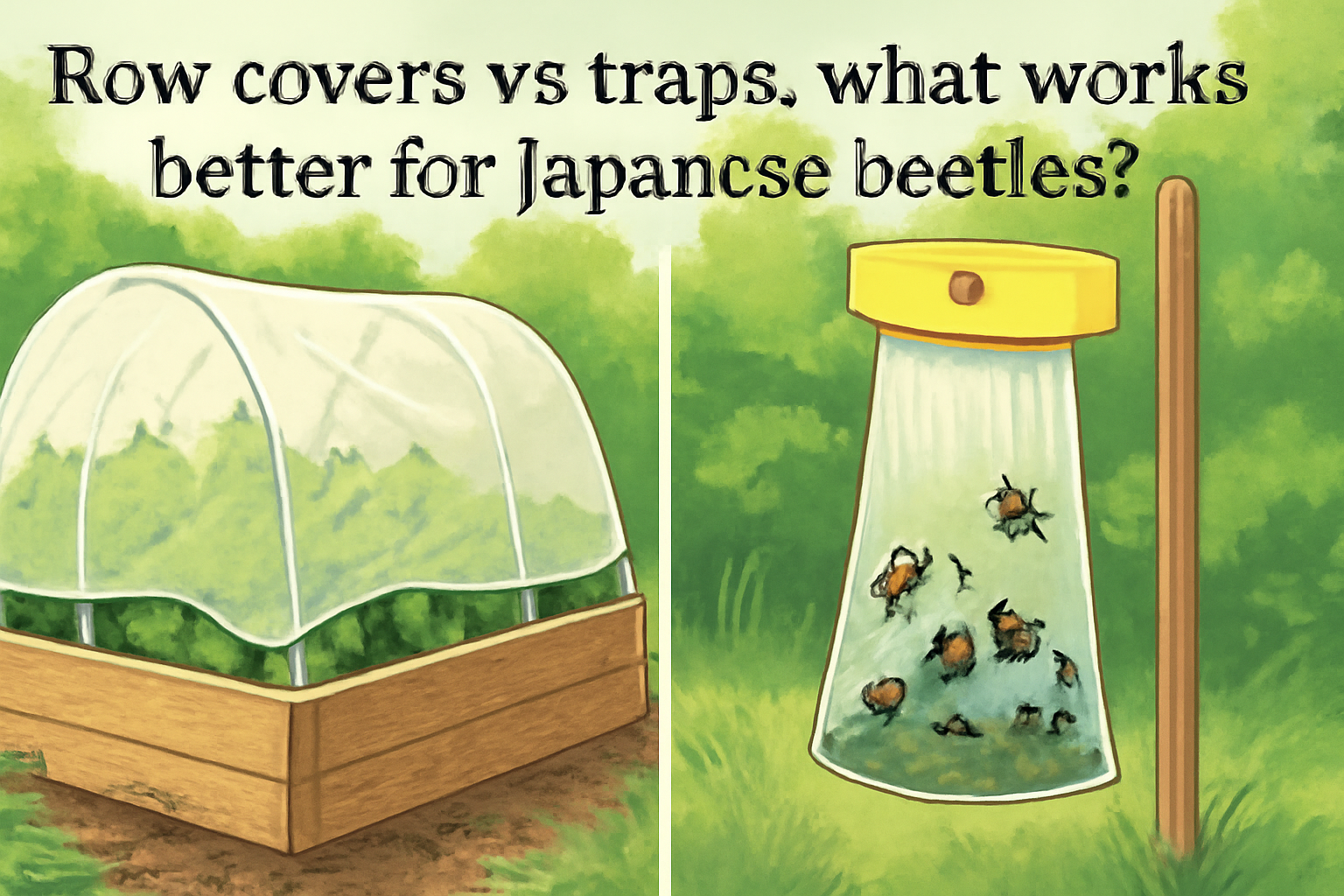
Row covers and Japanese beetle traps represent two distinct approaches to controlling these devastating garden pests. Choosing the right method can mean the difference between a successful harvest and devastated plants. In this guide, I’ll share what 10+ years of battling these metallic pests has taught me about which control method works best in different situations, helping you make the right choice for your garden.
Understanding Japanese Beetle Biology: Why It Matters for Control Methods
Before comparing row covers and traps, it’s essential to understand the Japanese beetle’s life cycle and behavior, as this knowledge directly impacts which control method will work best in your situation.
Japanese beetles are distinctive insects measuring 8-11mm long with a metallic green body and copper-brown wing covers. Their white tufts of hair along the abdomen sides make identification straightforward. These pests follow a complete metamorphosis with four life stages: egg, larva (grub), pupa, and adult.
Adult beetles typically emerge from the soil in late May to early July, depending on your region. Weather patterns, especially during monsoon seasons, can significantly affect Japanese beetle emergence timing and outbreak severity. Once emerged, adults feed actively for 6-8 weeks, causing significant damage before laying eggs in the soil.
| Photo | Popular Pest Repellents | Price |
|---|---|---|

|
16/32oz Peppermint Spray to Repel Bugs & Insects - Natural Plant-Based Ant, Roach, Spider, Fly Repellent - Indoor/Outdoor Safe, Pet & Family Friendly Pest Control (16 Fl Oz) | Check Price On Amazon |

|
Nature's Dome Pest Control Starter Kit – Makes 3 Bottles (16 oz Each) – Eco-Friendly, Plant-Based Formula for Ant, Roach, Spider, Fly, Flea & Insect Control – Child & Pet Safe for Indoor/Outdoor Use | Check Price On Amazon |

|
(2025 Upgraded) Ultrasonic Insect & Pest Indoor Repeller – Stronger Driving Force, Plug-in Control Electronic Repellent for Roach, Mouse, Rodent, Bugs, Spider, Mice, Ant, 2 Mode Switching (6 Pack) | Check Price On Amazon |

|
LONYEON 8L Electric ULV Cold Fogger Machine with Backpack Mist Atomizer, Adjustable Flow Rate, Large Area Spraying for Home Indoor Outdoor | Check Price On Amazon |

|
Pest Control, Mouse Repellant Pouches, 10 Pack, Mice Repellent Indoor, Peppermint Oil for Rodents & Cucarachas & Spiders & Snakes, Safe Effective Rodent Repellent for Car Engines, RV, Home Use | Check Price On Amazon |
What makes these beetles particularly destructive is their feeding preferences. They target over 300 plant species, with special preference for roses, grapes, lindens, birch, and many fruit trees. They typically feed in groups, starting at the top of plants and working downward, leaving behind skeletonized leaves with only the veins remaining.
- Adults emerge in early summer and feed for 6-8 weeks
- They prefer feeding in groups, maximizing damage
- Beetles are most active on warm, sunny days
- They target plant tissue between leaf veins, causing distinctive skeletonization
- One generation occurs per year in most regions
Understanding this life cycle helps explain why certain control methods work better than others in specific situations. Now, let’s examine how row covers and traps target different aspects of beetle behavior.
Row Covers for Japanese Beetle Control: How They Work
Row covers function as a physical barrier, preventing Japanese beetles from reaching and feeding on your plants. This preventive approach addresses the problem before damage occurs.
Row covers are typically made from lightweight, semi-transparent fabrics that allow light, water, and air to reach plants while creating a physical barrier against insects. The most common materials include lightweight floating row covers (weighing 0.5-0.6 oz per square yard) and insect barrier fabrics (0.8-1.0 oz per square yard).
These covers work by creating a simple physical obstacle that prevents adult beetles from landing on and accessing your plants. When installed properly, row covers provide nearly 100% protection against Japanese beetles, as the adults cannot penetrate the fabric barrier.
For maximum effectiveness, covers should be installed before adult beetles emerge in your area, typically in late spring. Securing row covers properly in high wind areas requires special techniques to prevent them from blowing away or creating gaps where beetles can enter.
I’ve found that proper installation is crucial for success. The covers must reach the ground on all sides and be secured with soil, rocks, or stakes to prevent beetles from crawling underneath. For taller plants or those requiring pollination, hoops or frames can provide support and allow periodic uncovering.
Pros and Cons of Row Covers
Pros:
- Provides nearly 100% protection when properly installed
- Creates a chemical-free barrier
- Prevents damage entirely rather than responding after it occurs
- Works against multiple pest species simultaneously
- Reusable for 2-3 seasons with proper care
- Relatively low cost over multiple seasons ($20-40 for materials to cover several plants)
Cons:
- Can interfere with pollination of flowering plants
- May require structural support for taller plants
- Can increase temperature around plants in hot weather
- Impacts garden aesthetics during the protection period
- Requires careful installation to prevent beetle entry
- Not practical for very large plants or extensive areas
While row covers provide a physical barrier to prevent beetle damage, traps take a completely different approach by attracting and capturing adult beetles. Let’s examine how these traps function and their effectiveness.
Japanese Beetle Traps: Design, Attractants, and Effectiveness
Japanese beetle traps use powerful attractants to lure adult beetles and then capture them, removing them from the potential breeding population and reducing plant damage in the process.
Most commercial Japanese beetle traps consist of two main components: an attractant lure and a collection container. The attractants typically combine two types of lures: a floral scent (usually geraniol) that mimics preferred food plants and a sex pheromone (typically japonilure) that attracts male beetles. This dual-lure system creates a powerful attraction mechanism that can draw beetles from up to a quarter-mile away.
The collection mechanism varies between trap designs but typically involves either a bag or canister into which beetles fall after being attracted to the lure. Once inside, the beetles cannot escape and eventually die.
Trap effectiveness can be impressive in terms of capture numbers. A single trap can collect thousands of beetles within a week during peak season. However, this visible evidence of “success” can be misleading. According to research from the University of Kentucky, traps rarely capture more than 75% of the beetles attracted to an area, leaving many to feed on nearby plants.
Proper placement is absolutely critical for trap effectiveness. Based on my experience working with homeowners, the number one mistake people make is placing traps too close to the plants they want to protect. Traps should be positioned at least 30-50 feet away from valuable plants to draw beetles away rather than toward them.
Pros and Cons of Japanese Beetle Traps
Pros:
- Provides visible results as beetles are captured
- Does not cover plants, allowing normal growth and pollination
- Easy to set up with minimal equipment
- Works during flowering periods when row covers might be problematic
- Can reduce beetle population over time
- Allows monitoring of beetle population levels
Cons:
- Can attract more beetles to your property than would otherwise arrive
- Requires regular emptying and maintenance (every 1-3 days during peak season)
- Only captures a portion of attracted beetles (typically 50-75%)
- Creates unpleasant odor as captured beetles decompose
- Ongoing cost for replacement bags and lures ($10-20 per season)
- May increase damage if improperly placed near valued plants
Now that we understand how both row covers and traps work individually, we can make a direct comparison between their effectiveness in different garden situations.
Direct Comparison: Row Covers vs Traps for Japanese Beetle Control
The effectiveness of row covers versus traps depends on multiple factors including your garden type, the plants you’re protecting, and your specific goals. This head-to-head comparison will help you determine which method better suits your situation.
| Factor | Row Covers | Traps |
|---|---|---|
| Effectiveness | 95-100% protection when properly installed | Captures 50-75% of attracted beetles |
| Initial Cost | $20-40 for materials to cover several plants | $10-15 per trap |
| Ongoing Costs | Replacement every 2-3 seasons | New lures and bags yearly ($10-20) |
| Ease of Implementation | Moderate (requires careful installation) | Easy (simple setup) |
| Maintenance | Low (occasional repositioning) | High (emptying every 1-3 days) |
| Duration of Protection | Entire beetle season | Varies based on trap capacity and emptying frequency |
| Impact on Plant Health | May increase temperature; can affect pollination | No direct impact on plants |
| Effect on Beneficial Insects | Blocks all insects, including beneficials | Minimal impact (beetle-specific) |
| Visual Impact | High (covers are visible in garden) | Moderate (traps can be placed discreetly) |
| Best For | Small gardens, high-value plants, vegetable gardens | Flowering plants, large areas, ornamental landscapes |
Dr. David Smitley, entomologist at Michigan State University, notes: “Row covers provide nearly complete protection but at the cost of plant access, while traps may actually increase local beetle density if not properly placed away from valued plants.”
In my professional experience, the most significant factor determining success is matching the method to your specific garden situation. Row covers excel at providing complete protection for smaller, high-value plantings, while traps may be more practical for larger landscapes where covering all plants isn’t feasible.
One critical factor often overlooked is the density of Japanese beetles in your area. In regions with extremely high beetle populations, traps can quickly become overwhelmed, while row covers maintain their effectiveness regardless of beetle pressure.
With this direct comparison in mind, let’s explore the scientific evidence behind the effectiveness of both methods to help you make an informed decision.
Scientific Evidence: What Research Shows About Japanese Beetle Control Methods
University studies and extension service research provide valuable insights into the comparative effectiveness of row covers and traps for Japanese beetle control. Here’s what the scientific evidence reveals.
Research from the University of Kentucky’s Department of Entomology has consistently shown that properly installed row covers provide nearly 100% protection against Japanese beetle damage. A 2018 study found that lightweight row covers (0.5 oz/sq yd) were as effective as heavier materials while causing less heat buildup around plants.
Regarding traps, Cornell University research demonstrated that while commercial Japanese beetle traps do capture large numbers of beetles, they rarely reduce damage to nearby plants. Their studies showed that traps can attract up to four times more beetles to an area than would otherwise be present, with only about 75% of those attracted actually being captured.
According to Dr. Daniel Potter, a renowned entomologist specializing in Japanese beetle control: “The evidence clearly shows that Japanese beetle traps tend to bring more beetles into your yard than they trap. Unless your neighbors are also trapping at least 30 feet from your property line, you may end up with more beetles than if you didn’t trap at all.”
Research from Purdue University on the “drawing power” of traps concluded that attractants can lure beetles from up to a quarter-mile away, which explains why proper placement is so critical. Their studies found that plants within 30 feet of traps typically suffered more damage than plants in control gardens with no traps.
A USDA Agricultural Research Service study found that combining control methods provided the best results, with row covers on high-value plants and strategically placed traps at property perimeters showing greater overall reduction in damage than either method alone.
- Row covers consistently provide 95-100% protection in controlled studies
- Traps can attract beetles from up to 1/4 mile away
- Only 50-75% of attracted beetles are typically captured by traps
- Plants within 30 feet of traps often suffer increased damage
- Integrated approaches combining methods show superior results
Based on this research evidence, we can now provide specific recommendations for when to use row covers versus traps in different garden situations.
When to Choose Row Covers: Garden Scenarios and Implementation
Row covers are the superior choice in several specific garden situations. Understanding when to use them and how to implement them correctly can make the difference between success and failure.
Ideal Scenarios for Row Covers
Based on both research and my field experience, row covers are particularly effective in these situations:
- Vegetable gardens where complete protection is desired
- Young or newly established plants vulnerable to beetle defoliation
- High-value ornamentals that cannot tolerate any damage
- Gardens in areas with extremely high Japanese beetle pressure
- When protection from multiple pest species is needed simultaneously
- For plants that have completed their pollination before beetle emergence
- When you need guaranteed protection with minimal maintenance
Row covers are especially valuable for protecting roses, grapevines, and young fruit trees, which are among Japanese beetles’ favorite targets. I’ve consistently seen near-complete protection of these susceptible plants when covers are properly installed.
Step-by-Step Implementation Guide
- Timing: Install covers 1-2 weeks before expected beetle emergence in your area (typically late May to early June)
- Material Selection: Choose lightweight row cover fabric (0.5-0.6 oz/sq yd) for most plants; use slightly heavier material (0.8-1.0 oz/sq yd) for longer-term protection
- Support Structure: For taller plants or rows, install hoops or frames before adding covers; PVC pipes, wire hoops, or ready-made garden hoops work well
- Proper Sizing: Cut fabric to allow 1-2 feet of extra material on all sides to ensure complete coverage and ground securing
- Installation: Gently drape material over plants or support structures, ensuring no plant parts extend beyond the cover
- Securing: Bury edges 2-3 inches deep in soil or secure with landscape pins, rocks, or boards to create a complete seal
- Pollination Access: For plants requiring pollination during beetle season, consider installing covers with one side secured with clips or ties for easy temporary access
- Monitoring: Check weekly for tears or gaps and repair immediately
For plants requiring structural support, I recommend using flexible PVC hoops or commercially available row cover hoops. Space these every 3-4 feet and secure the cover to them using clips or clothespins for easy removal when needed.
In my work with community gardens, I’ve found that using soil to secure edges creates the most reliable seal against beetles. However, in areas with frequent high winds, using a combination of soil and landscape fabric pins provides better stability and prevents covers from blowing open.
While row covers work best in the scenarios described above, traps may be the better option in different garden situations. Let’s explore when traps should be your preferred method.
When to Choose Traps: Garden Scenarios and Implementation
Japanese beetle traps offer specific advantages in certain garden situations. Here’s when to choose traps over row covers and how to implement them for maximum effectiveness.
Ideal Scenarios for Traps
Based on research and practical field experience, Japanese beetle traps work best in these situations:
- Large properties where covering all plants isn’t practical
- Flowering plants requiring pollination during beetle season
- Gardens where visual appearance during growing season is paramount
- As part of a community-wide control effort with neighbors
- When physical limitations make row cover installation difficult
- For mature trees and large shrubs that cannot be practically covered
- When monitoring beetle populations is desired
- As a perimeter defense system for larger properties
Traps can be particularly useful for ornamental landscapes where aesthetics are important and the use of row covers would detract from the garden’s appearance. They’re also valuable when you need to continue monitoring beetle populations to determine if additional control measures are needed.
Step-by-Step Implementation Guide
- Strategic Placement: Position traps at least 30-50 feet away from any plants you want to protect
- Trap Selection: Choose traps with both floral and sex pheromone lures for maximum effectiveness
- Installation Height: Mount traps about 4 feet above ground level on a stake or post
- Perimeter Strategy: For larger properties, place multiple traps around the perimeter to intercept beetles
- Sun Exposure: Position in sunny locations, as beetles are more active in sunny areas
- Wind Consideration: Place downwind from valuable plants when possible, as beetles often fly upwind toward attractants
- Maintenance Schedule: Empty traps every 1-3 days during peak season to prevent overflow and odor
- Disposal Method: Seal captured beetles in plastic bags and dispose of in trash, or submerge in soapy water
- Lure Replacement: Replace attractant lures according to manufacturer instructions (typically every 4-6 weeks)
In my consulting work, I’ve found that the biggest mistake homeowners make with traps is placing them too close to valued plants. Remember that traps attract beetles from a wide area but only capture a portion of those attracted. The remaining beetles will feed on nearby plants, potentially increasing damage.
For optimal results with trap placement, I recommend a “perimeter defense” approach. Place traps around the edges of your property, ideally near less valuable plants or non-host plants. This creates an interception zone that can capture beetles before they reach your prized plants.
For many gardeners, the most effective approach combines multiple control methods. Let’s explore integrated strategies that incorporate both row covers and traps along with complementary techniques.
Integrated Approaches: Combining Row Covers, Traps, and Other Control Methods
The most successful Japanese beetle management programs often integrate multiple control methods. Here’s how to combine row covers, traps, and other techniques for comprehensive protection.
Strategic integration of both row covers and traps allows you to maximize the strengths of each method while minimizing their weaknesses. Based on USDA research and my own field observations, here’s an effective integrated approach:
- Prioritize Plants: Identify your most valuable and susceptible plants for row cover protection
- Establish a Perimeter: Place traps at property boundaries, 30-50 feet from valued plants
- Create Sacrificial Areas: Plant less valuable “trap crops” near your traps to divert feeding
- Implement Biological Controls: Apply beneficial nematodes to lawn areas in fall or spring to target grubs
- Practice Manual Removal: Hand-pick beetles in early morning when they’re sluggish, dropping them into soapy water
- Consider Resistant Plants: Gradually replace highly susceptible plants with resistant varieties
I’ve worked with several community garden projects that successfully implemented this integrated approach. One notable example reduced Japanese beetle damage by over 80% by using row covers on high-value vegetables, strategically placed traps at the garden perimeter, and a community-wide beneficial nematode application for grub control.
Complementary control methods that work well within an integrated approach include:
- Beneficial Nematodes: Heterorhabditis bacteriophora applied to soil targets grubs
- Milky Spore: A biological control that can provide long-term grub suppression (though it takes 2-3 years to establish)
- Botanical Repellents: Essential oils like rosemary or peppermint oil can provide some repellent action against Japanese beetles on certain plants
- Companion Planting: Garlic, chives, and catnip can have modest repellent effects when interplanted
- Timed Irrigation: Avoid watering lawns during peak adult flight to make egg-laying less favorable
Dr. Clifford Sadof of Purdue University notes: “The best Japanese beetle management occurs when multiple tactics are employed simultaneously, addressing different stages of the beetle’s life cycle and creating multiple barriers to success for the pest.”
Proper implementation is crucial for success with any Japanese beetle control method. Let’s examine common mistakes and troubleshooting solutions for both row covers and traps.
Troubleshooting: Common Problems and Solutions for Both Methods
Even when using the right control method, implementation issues can reduce effectiveness. Here are common problems gardeners encounter with both row covers and traps, along with practical solutions.
Row Cover Troubleshooting
Problem: Beetles getting under covers
Solution: Check entire perimeter for gaps or loose sections. Secure edges by burying 2-3 inches of material in soil or using a continuous line of heavy objects (bricks, boards, etc.) to create a complete seal. Inspect daily during peak beetle season.
Problem: Plants overheating under covers
Solution: Use lightweight row cover material (0.5-0.6 oz/sq yd) that allows 85-90% light transmission. In very hot weather, consider temporary shade cloth over the row covers during the hottest part of the day, or use supports to create more air space between plants and covers.
Problem: Pollination issues with flowering plants
Solution: For plants requiring pollination, uncover during morning hours (before beetles become active) to allow pollinators access, then recover before beetle activity increases. Alternatively, hand-pollinate using a small brush or cotton swab to transfer pollen between flowers.
Problem: Cover damage from weather or sharp plant parts
Solution: Repair small tears immediately with garden tape or stitch with thread. For plants with thorns or sharp edges, place bamboo stakes with cotton balls on tips at potential friction points to prevent tears, or use double layers of covering at vulnerable points.
Problem: Difficulty accessing plants for maintenance
Solution: Install covers with one side secured using clothespins or clips rather than burying in soil, allowing temporary access. Alternatively, create a “door” by cutting a slit and reinforcing edges with tape, then securing with clothespins when closed.
Trap Troubleshooting
Problem: Attracting more beetles but not reducing damage
Solution: Reposition traps further from valued plants (minimum 30-50 feet). If property size doesn’t allow adequate distance, consider abandoning traps in favor of other methods. Remember that traps work best as perimeter protection, not near-plant protection.
Problem: Low capture rates despite beetle presence
Solution: Check and replace attractant lures according to manufacturer guidelines (typically every 4-6 weeks). Ensure traps are placed in sunny locations, as beetles are less active in shaded areas. Verify that collection bags are properly attached with no escape routes.
Problem: Trap damage from weather or animals
Solution: Secure traps firmly to stakes that are deeply planted. For animal interference (particularly raccoons attracted to beetles), mount traps higher (5-6 feet) or surround with a wire cage that allows beetles entry but prevents larger animals from accessing the collection container.
Problem: Odor issues from decomposing beetles
Solution: Empty traps much more frequently (every 1-2 days during peak season). Add a tablespoon of baking soda to collection bags to help neutralize odors. Position traps downwind from patios, windows, and outdoor living areas.
Problem: Traps fill too quickly to maintain
Solution: In areas with extremely high beetle populations, add more traps to distribute the capture load, use traps with larger collection capacity, or consider switching to row covers for highest-priority plants while maintaining fewer traps as perimeter defense.
With effective troubleshooting knowledge, you can optimize whichever method you choose. Now let’s address some frequently asked questions about Japanese beetle control.
Japanese Beetle Control: Frequently Asked Questions
Gardeners often have specific questions about Japanese beetle control methods. Here are expert answers to the most common questions about row covers, traps, and general beetle management.
Will killing Japanese beetles attract more?
No, crushing or killing individual beetles does not attract more beetles. This is a common misconception. However, the pheromones in commercial traps do actively attract beetles from surrounding areas, which is why proper trap placement away from valued plants is crucial.
How far should traps be placed from valued plants?
Research from multiple university studies consistently recommends placing traps a minimum of 30 feet from any plant you want to protect, with 50 feet being ideal. This distance helps ensure that beetles attracted to the area but not captured don’t end up feeding on your prized plants.
Can row covers be used on mature plants?
Yes, row covers can be used on mature plants, but proper support structures become increasingly important as plant size increases. For larger plants, create a frame using garden stakes, PVC pipes, or metal hoops to prevent the cover from resting directly on foliage, which can cause damage or restrict growth.
Do homemade traps work as well as commercial ones?
Generally, no. While homemade traps using food baits like fruit can attract some beetles, they lack the powerful sex pheromones present in commercial lures that can attract beetles from up to 1/4 mile away. Commercial traps typically capture significantly more beetles than homemade versions.
Can Japanese beetles develop resistance to trap attractants?
No, there is no evidence that Japanese beetles develop resistance to the pheromones and floral lures used in commercial traps. These attractants mimic natural biological signals that are fundamental to the beetles’ reproductive and feeding behavior.
How do weather conditions affect trap and row cover effectiveness?
Weather significantly impacts beetle activity and control methods. Traps are most effective on warm, sunny days when beetles are most active; effectiveness decreases during cool or rainy periods. Row covers maintain their physical barrier regardless of weather, but may require additional securing during high winds.
Is it better to trap or kill Japanese beetles?
Individual hand-picking and killing beetles directly on plants (dropping them into soapy water) can be more effective than trapping for protecting specific plants, as it removes beetles already causing damage without attracting more. However, this method is labor-intensive and only practical for smaller gardens or particularly valuable plants.
How do these methods affect beneficial insects?
Row covers exclude all insects, including beneficials like pollinators and predators. This can be problematic for plants requiring pollination or natural pest control. Traps are much more selective, primarily attracting Japanese beetles, though they occasionally capture non-target insects like bumblebees or native beetles in small numbers.
With these common questions addressed, let’s summarize the key points to help you make your final decision between row covers and traps.
Conclusion: Making Your Final Decision Between Row Covers and Traps
When deciding between row covers and traps for Japanese beetle control, consider your specific garden situation, the plants you’re protecting, and your overall pest management goals.
Row covers provide nearly perfect protection through physical exclusion, making them ideal for:
- High-value plants that can’t tolerate any damage
- Smaller gardens where complete coverage is practical
- Vegetables and plants that don’t require pollination during beetle season
- Areas with extremely high beetle pressure
- Gardeners seeking a one-time setup with minimal maintenance
Japanese beetle traps offer a different approach that works better for:
- Larger landscapes where covering all plants isn’t feasible
- Gardens where aesthetics during growing season are important
- Plants requiring pollination throughout beetle season
- Perimeter defense of larger properties
- Monitoring beetle populations to guide other control decisions
For many gardens, the most effective approach is a strategic combination: using row covers on your most valuable and susceptible plants while placing traps at property perimeters to reduce the overall beetle population. This integrated approach, potentially combined with other natural pest control methods, offers the most comprehensive protection.
Remember that timing is crucial for both methods. Install row covers before beetle emergence, and set up traps at first beetle sighting for optimal results. With proper implementation of the method that best fits your situation, you can significantly reduce Japanese beetle damage and enjoy a more productive and beautiful garden.
